

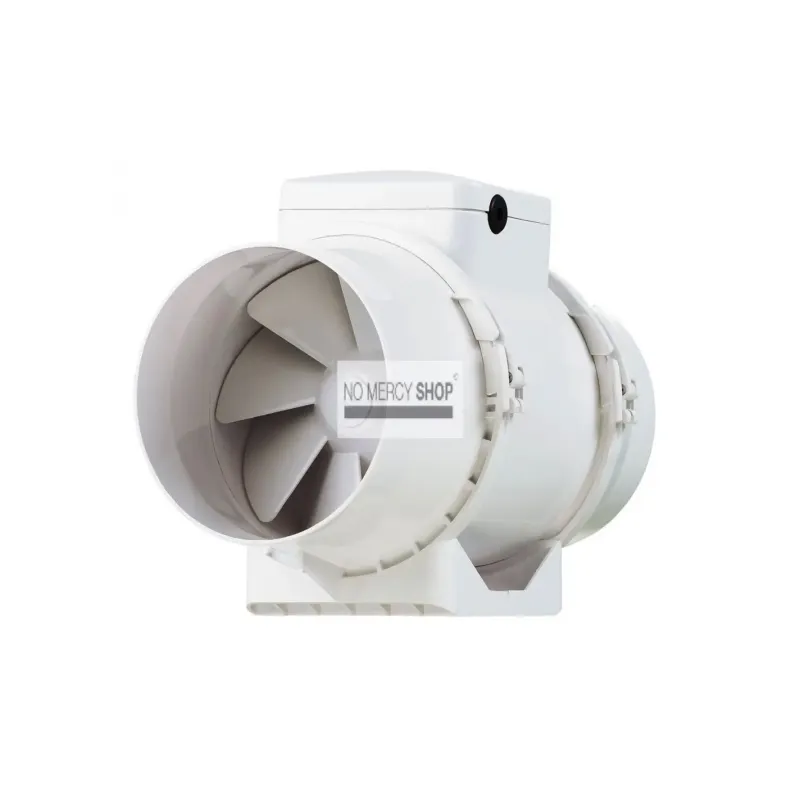
Vents TT 160 RV Mixed-flow fan Ø 160 MM / 405 M³ + 520 M³
An Ø160 mixed-flow fan with two speeds, 405 or 520 m³ per hour. Holds pressure better than an axial, so it suits a carbon filter.
- Vents
- Model: c320420
- EAN: 4823059388266

QUALITY

PAYMENT

SHIPPING

PACKAGED
Carefully selected products.
Fast and secure checkout experience.
EU-wide delivery from trusted stock.
Carefully and discreetly packaged.
An Ø160 mm inline fan with a mixed-flow impeller, two speeds of 405 and 520 cubic metres per hour and a built-in switch. Ball bearing mounted, thermally protected, and supplied with cord and plug.
Mixed flow sits between two shapes
An axial fan pushes air straight along its axis. It moves plenty of air while nothing is in the way, but its output falls away sharply as soon as there is resistance. A centrifugal fan flings air outward and holds pressure far better, but it is bigger and louder.
A mixed-flow impeller does a bit of both: air is driven backward and outward at once. The result is a fan that comes closer to centrifugal pressure behaviour in the body and noise level of an inline fan.
Which is exactly what you want the moment a carbon filter is in the line. A filter is resistance, and that resistance rises as the filter loads up. A fan that only reaches its rated figure into free air delivers less than the label promises in that setup.
Two speeds, and what they cost
The built-in switch picks between two speeds. On low the motor turns at 1680 rpm, moves 405 cubic metres per hour, draws 29 watts and reads 33 decibels at three metres. On high that becomes 2460 rpm, 520 cubic metres, 60 watts and 44 decibels.
Set those side by side and the trade is plain: the last 28 percent of airflow costs you more than double the power and eleven decibels. Eleven decibels is more than a doubling of perceived loudness. For most setups low is therefore the speed you run, with high held back for when it is really needed.
If you want finer control than two steps, an external speed controller or a timer with run-on delay can be connected. Both are sold separately.
Servicing without dismantling the ducting
The housing is plastic and the impeller with its motor block sits in it on a few clips. You release those and pull the complete block out while the housing stays in the duct. Cleaning therefore costs you no dismantling of your ventilation run, which is why you actually do it rather than put it off. The motor runs on ball bearings rated at 40,000 hours and carries thermal overload protection.
Technical Specifications:
- Connection size: Ø160 mm
- Airflow: 405 or 520 m³ per hour
- Speed: 1680 or 2460 rpm
- Power draw: 29 to 60 W
- Current: 0.17 to 0.27 A
- Supply: 230 V, 50/60 Hz
- Sound pressure at 3 metres: 33 to 44 dB
- Impeller: mixed flow
- Bearings: ball bearings, 40,000 hours
- Protection: thermal, against overload
- Maximum air temperature: 60 degrees
- Ingress rating: IP X4
- Mounting: inline, at any angle
- Weight: 2.65 kg
- Included: cord and plug
Frequently asked questions
Which speed do I need?
Start on low. That moves 405 cubic metres per hour at 33 decibels; high gives 28 percent more air for more than double the power and eleven decibels on top.
Can I control it steplessly?
Not with the built-in switch, which has two positions. An external speed controller can be connected and is sold separately.
Can it hang vertically?
Yes, the fan can be mounted at any point and at any angle in the duct run.
How do I clean it?
Release the clips, pull out the motor block with the impeller, clean it and put it back. The housing stays in the duct.
Is it suitable with a carbon filter?
That is what the mixed-flow shape is for, since it holds pressure better than a plain axial fan. Vents publish no pressure curve for this model, so a figure at a given resistance is not stated here.

across Europe

Top brands

across Europe
Top brands