

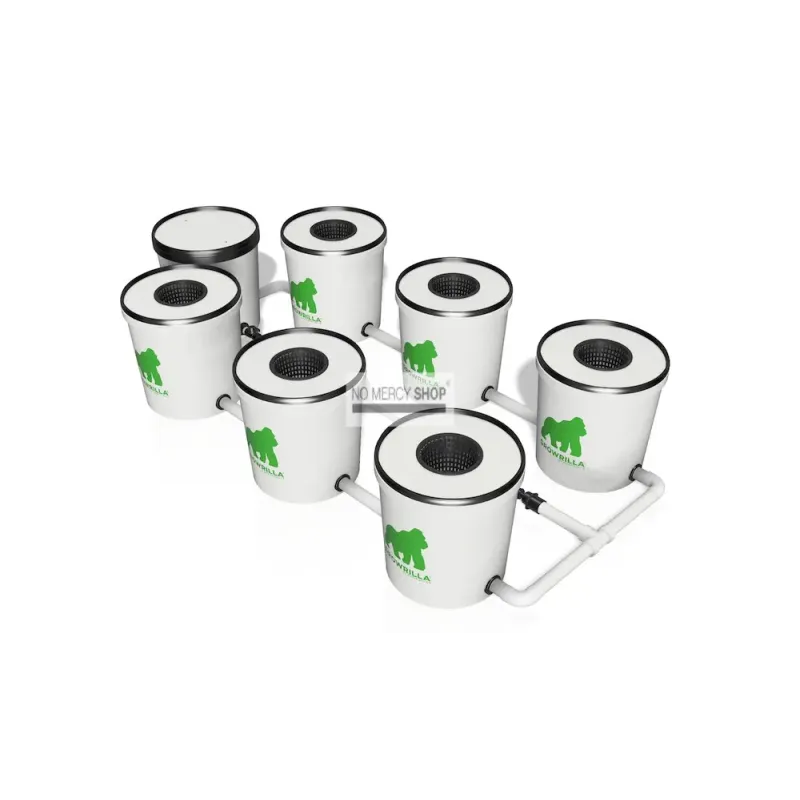
Growrilla Hydroponic system 2.0 RDWC 6
Six plants, recirculating.
- Growrilla
- Model: SI-GRO2006

QUALITY

PAYMENT

SHIPPING

PACKAGED
Carefully selected products.
Fast and secure checkout experience.
EU-wide delivery from trusted stock.
Carefully and discreetly packaged.
Six pots in two rows of three. This is where the pump hardware steps up as well as the pot count, and there is a reason for that.
The Growrilla Hydroponic System 2.0 RDWC 6 is the point in the range where the hardware changes. The water pump goes from the HX2500 to an HR1000 at 1050 L/h, and the air pump from a V20 to a V30 at 30 L/min. Power draw goes from 27 to 52 watt.
The footprint stays 80 centimetres wide and only gets longer: 80 by 145. The system still fits along one side of a tent, which means you can reach every pot without leaning over anything. Recommended growing area is 120 by 150.
Why oxygen is the bottleneck, not nutrition
Most growers think about nutrients first when they think about a hydroponic system. Yet it is almost never nutrition that sets the ceiling: it is the oxygen in the water.
A root is not a passive straw. It is living tissue that respires, and respiration costs oxygen. Roots in soil take it from the air pockets between particles, which is exactly why compacted, waterlogged soil kills plants. In deep water culture there are no air pockets. Every bit of oxygen a root gets has to be dissolved in the water.
That works, and works exceptionally well, because dissolved oxygen is immediately available without the root having to grow anywhere to find it. But water can only hold a limited amount, and a growing root mass consumes it faster than you would expect. Without replenishment the supply in a pot is gone within hours.
That is the air pump's job. The air stone in each pot pushes fine bubbles through the solution, and "fine" is the part that matters: a hundred small bubbles have far more surface area in contact with the water than one large one, and oxygen dissolves where air and water meet. Coarse bubbles rush through the pot and break at the surface without giving up much at all.
So six pots do not need three times the air of two because there are three times as many pots, but because each pot has to maintain its own independent supply. Hence the V30 in place of the V20.
What the heavier water pump buys you
The HR1000 moves 1050 litres an hour. With 105 litres in the system, the entire contents turn over roughly ten times an hour.
You notice that at two moments. First when correcting: pour pH down into the controller pot and it has evened out across all six pots before you have put your meter away. Second in consistency. Slow circulation creates differences between the first and last pot in a row, and those differences are exactly what a recirculating system was supposed to eliminate.
Circulation also helps aeration along. Moving water picks up oxygen at the surface. Not as much as the air stones deliver, but it adds up.
Technical Specifications:
- System type: RDWC recirculating hydroponic system
- Growing pots: 6 x 19 litre (Ø 30 x h 33 cm)
- System rows: 2
- System water volume: 105 litre
- Plant spacing: 50 cm
- System footprint: 80 x 145 cm
- Recommended growing area: 120 x 150 cm
- System power: 52 watt
- Air pump: Hailea V30 (30 L/min, 1800 L/h)
- Water pump: Hailea HR1000 (1050 L/h)
Frequently asked questions
Does the air pump have to run day and night?
Yes, continuously. Switch it off overnight and dissolved oxygen runs down while the roots keep respiring. This is not the component to save electricity on.
Can I put the air pump outside the tent?
That is actually preferable. It makes noise, and it draws air from wherever it stands. Outside the tent that air is cooler and drier. Keep the tubing as short as is practical.
How do I know if my aeration is enough?
Look at the roots. Healthy DWC roots are white to pale cream and feel firm. Brown, slimy or musty-smelling root tissue almost always means too little oxygen, water that is too warm, or both.
Why is this more expensive per pot than the RDWC 8?
Because the heavier pumps appear here for the first time in the range, and the RDWC 8 uses the same set for two more pots. Purely on cost per plant the eight-pot system is better value: if you have the space for it.
How often should air stones be replaced?
Once per grow is a good habit. They clog slowly with salts and biofilm, and it happens gradually enough that you will not notice until the bubbles are visibly coarser.

across Europe

Top brands

across Europe
Top brands