

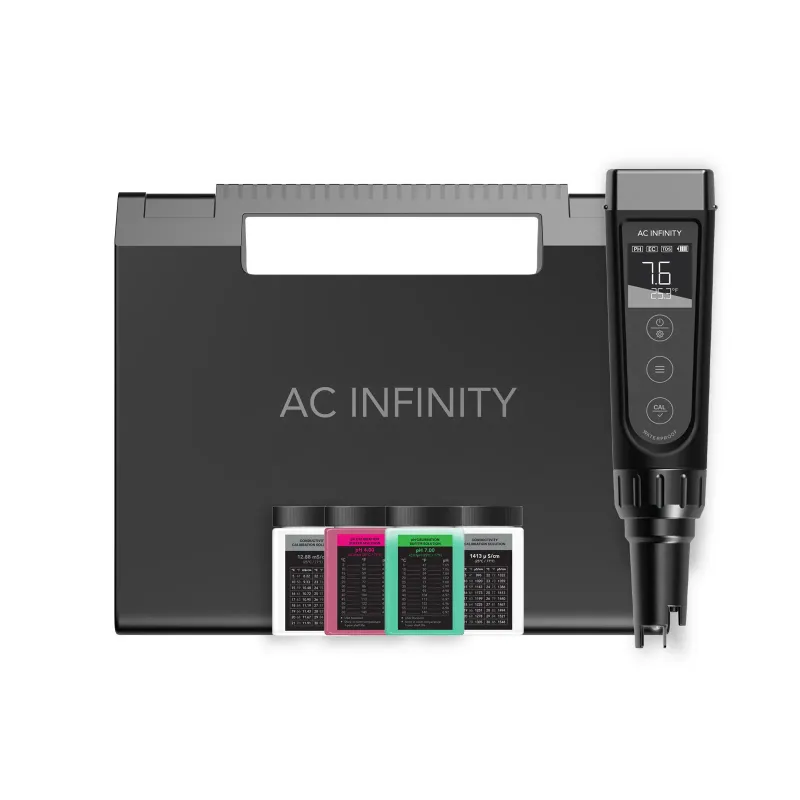
AC Infinity Hydroponic Meter PRO Kit
The most complete kit: for monitoring a hydroponic setup.
- AC Infinity
- Model: AC-PHM7
- EAN: 0819137024212

QUALITY

PAYMENT

SHIPPING

PACKAGED
Carefully selected products.
Fast and secure checkout experience.
EU-wide delivery from trusted stock.
Carefully and discreetly packaged.
Reads pH, EC, TDS, salinity and temperature from one pen. Replaceable probe, IP67, and four buffers plus storage solution in the kit.
The AC Infinity Hydroponic Meter PRO Kit replaces two or three separate meters. Stated pH accuracy is ± 0.01, the probe is replaceable, and the kit ships with buffers at pH 4.00 and 7.00 plus 12.88 mS and 1413 µS for the EC side, along with a 3M KCl storage solution.
Those four buffers are not a luxury. A combi meter has to be calibrated on two fronts. PH and conductivity are two separate measurements in one housing, and each needs its own reference.
EC, TDS and ppm: why one water gives you three numbers
This is the most confusing corner of measuring nutrients, and the reason growers on forums talk straight past each other.
What a meter actually measures is EC: how well the water conducts electricity. More dissolved salts means better conduction. That is a direct measurement, in mS/cm or µS/cm.
TDS: total dissolved solids, in ppm: is not a separate measurement. It is the EC value converted using a fixed factor. And there is the problem: there is no single correct factor.
- The 500 scale uses a factor of 0.5. Common on American brands and in many feed schedules.
- The 700 scale uses 0.7. Also widespread, including in Australia.
The consequence, concretely: water at EC 2.0 mS/cm is 1000 ppm on the 500 scale and 1400 ppm on the 700 scale. Same water, same measurement, two numbers 400 ppm apart. Follow a schedule written in ppm without knowing which scale the author used and you can be 40% out.
There is also CF, which you meet on Bluelab meters and the Truncheon. That is simply EC times ten: EC 2.0 is CF 20. No factor, no confusion.
The practical advice: work in EC. It is the real measurement, it contains no assumption, and any feed schedule can be converted back to it. If you are following a schedule in ppm, find out which scale is meant before you mix anything.
Technical Specifications:
- Model: AC-PHM7 (PRO Kit)
- Measures: pH, temperature, EC, TDS, salinity and alkalinity (manufacturer's list)
- pH accuracy: ± 0.01 pH (manufacturer's figure)
- Probe: replaceable, lithium-glass membrane
- Protection rating: IP67, dust- and waterproof
- Dimensions: 4.2 x 3.3 x 17.8 cm
- Kit contents: PRO meter, 3M KCl storage solution, buffers at pH 4.00 and 7.00 and 12.88 mS and 1413 µS, probe guard
Frequently asked questions
Does it really measure alkalinity?
The manufacturer lists alkalinity among its readings. Be clear on what that is: alkalinity is water's buffering capacity, normally determined by titration rather than with an electrode. A figure from a pen like this is therefore a derived estimate, not a measured quantity. For your crop, pH and EC are the numbers you steer on.
Do I calibrate pH and EC separately?
Yes. They are two different measurements, each needing its own reference solution: hence the four bottles in the kit.
How often does the EC side need calibrating?
Less often than the pH side. A conductivity sensor is considerably more robust than a glass pH membrane. It does foul with salt build-up though, so keeping it clean matters more than calibrating often.
Does this replace two separate meters?
Functionally yes. Bear in mind that one probe is also one point of failure: if it goes, you lose both readings at once. With two separate meters you always still have the other.
Why does this include storage solution when the entry kit does not?
Because the probe here is replaceable and more expensive, and KCl storage solution extends its life considerably. Stored dry, any pH membrane dies.

across Europe

Top brands

across Europe
Top brands