

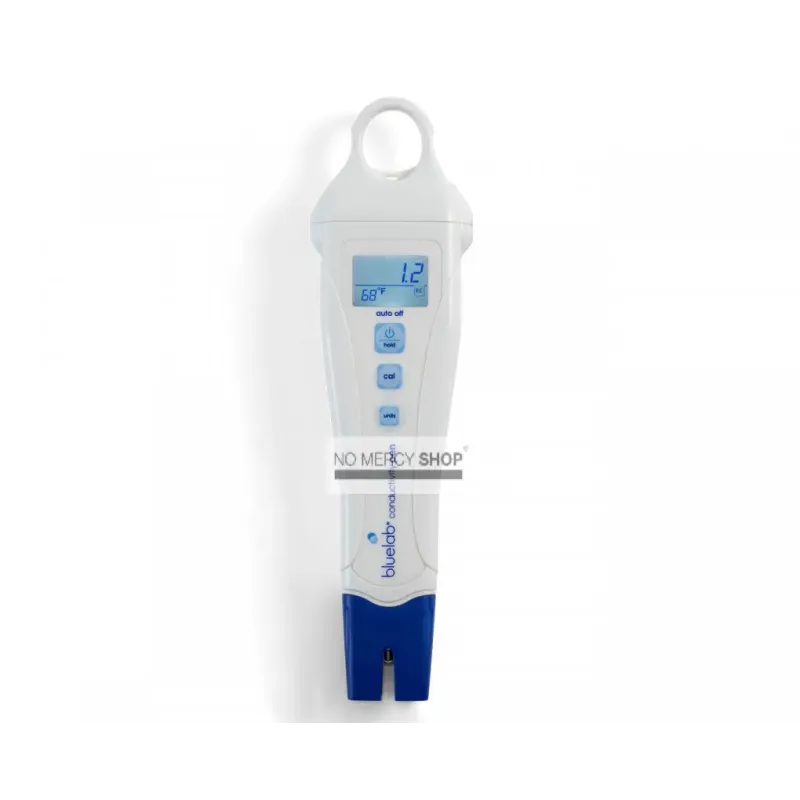
Bluelab EC pen
A pen for conductivity (EC or ppm) and temperature.
- Bluelab
- Model: 5011
- EAN: 9421024920227

QUALITY

PAYMENT

SHIPPING

PACKAGED
Carefully selected products.
Fast and secure checkout experience.
EU-wide delivery from trusted stock.
Carefully and discreetly packaged.
Measures how much nutrient is in your water, plus temperature. Waterproof, with automatic temperature compensation and a calibration reminder after thirty days.
The Bluelab Conductivity Pen reads your nutrient solution from 0.0 to 10.0 EC, at a resolution and accuracy of 0.1. You choose the unit you read in (EC or ppm) and temperature comes alongside in °C or °F. Calibration is single-point with EC 2.77, and optional.
What EC measures, and what it cannot tell you
An EC meter does not measure nutrient. That sounds odd for an instrument you buy to watch your feed, but it is exactly what you need to know to use one properly.
What actually happens: the pen passes a small current through the water and measures how well it conducts. Pure water barely conducts at all. Dissolve salts in it and the water starts conducting, and the more dissolved salts the better it does so. That conductivity is your EC value.
And there is the limitation: the meter has no idea which salts they are. Nitrogen, potassium and calcium from your feed conduct. But sodium and chloride from hard tap water conduct just as well, and those are not nutrient to your plant.
Two consequences you meet in practice:
- Start with your tap water. Measure it before you add anything. If it already reads 0.4 EC, that is your baseline, and a target of 1.8 leaves only 1.4 of actual feed. Skip this and you systematically underestimate what you are giving.
- Rising EC in a recirculating system is not automatically too much feed. Plants take up water faster than salt, so what remains concentrates. Top up with water at a lower EC than your target, measure again, and only correct if needed.
So EC tells you how strong your solution is, not whether the ratio is right. For that you need a full water analysis, but for steering a crop day to day, strength is precisely what you need to know.
Why temperature is part of it
Conductivity rises with temperature. The same solution reads higher warm than cold, and without correction you see a difference that is not there. This pen compensates automatically, and shows you the temperature separately as well. Useful, since 18 to 22 °C is where you want to be.
Technical Specifications:
- EC range: 0.0 to 10.0 EC
- Resolution: 0.1 EC
- accuracy: ± 0.1 EC
- Units: EC or ppm, temperature in °C or °F
- Calibration: single point with EC 2.77 (optional)
- Calibration reminder: after 30 days, with successful-calibration indicator
- Temperature range: 0 to 50 °C (accurate to 1 °C)
- Temperature compensation: automatic
- Build: fully waterproof, backlit display, hold function, battery indicator, automatic shut-off
- Battery: 1 x AAA alkaline (included)
- Warranty: 1 year
Frequently asked questions
Why is calibration optional here when a pH meter needs it?
Because a conductivity sensor is far more stable than a glass pH membrane. It barely drifts. What does affect it is fouling, so keeping it clean matters more than calibrating often.
Should I work in EC or ppm?
In EC. That is the real measurement. Ppm is a conversion using a factor that differs between brands, so the same water produces different numbers.
Does this replace my pH meter?
No. EC says how much nutrient is in the water, pH says whether your plant can reach it. You need both; with EC alone you are steering blind.
Can I measure soil or coco with it?
No, this pen is for liquid. For readings in the medium itself, the Bluelab Pulse is the tool.
How do I keep it clean?
Rinse with clean water after use and clean the sensor periodically. Salt build-up is the only real enemy of an EC sensor.

across Europe

Top brands

across Europe
Top brands