

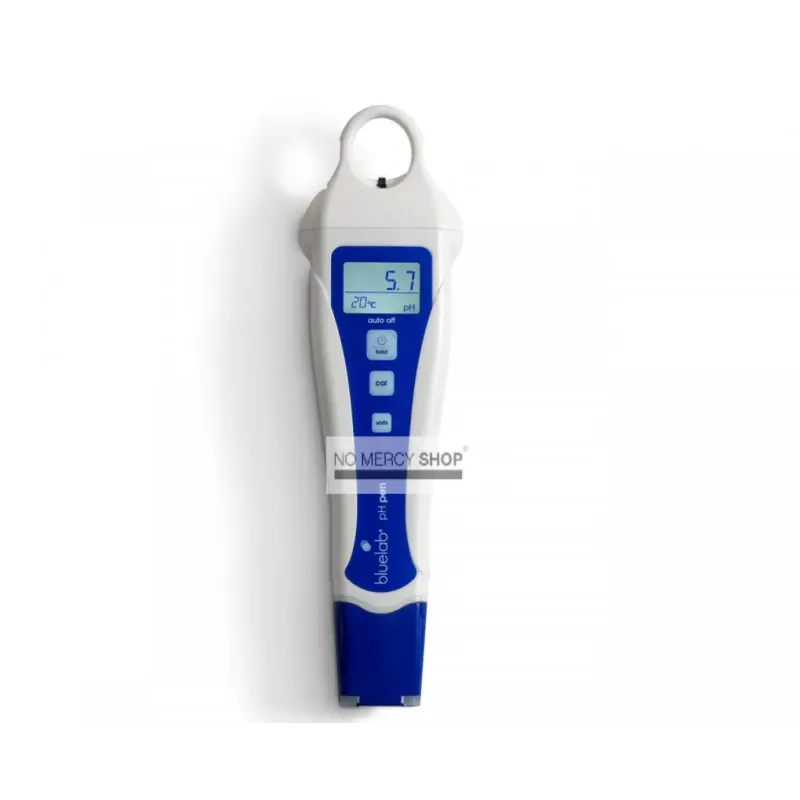
BlueLab pH pen
A pen reading pH and temperature, for a quick check in passing.
- Bluelab
- Model: b300000
- EAN: 9421024920234

QUALITY

PAYMENT

SHIPPING

PACKAGED
Carefully selected products.
Fast and secure checkout experience.
EU-wide delivery from trusted stock.
Carefully and discreetly packaged.
A waterproof pH pen that reads the temperature of your nutrient solution alongside its acidity. Three calibration points and a reminder when it is time to recalibrate.
The Bluelab pH Pen is the first real instrument most growers buy, and probably the most important one. It reads 0.0 to 14.0 pH to an accuracy of 0.1, measures solution temperature from 0 to 50 °C at the same time, and tells you on screen when your last calibration is thirty days old.
Waterproof, with a hold function to freeze a reading and automatic shut-off so you do not flatten the battery by leaving it in a pocket.
Why acidity decides whether your nutrients work at all
This is the thing growers most often have wrong, and it costs more crops than any other measurement error.
A plant draws its minerals from the nutrient solution, but not every mineral is available at every pH. Iron, manganese and phosphorus each behave differently. Run too high and iron precipitates into a form roots cannot take up. Run too low and other elements get squeezed instead.
The result is the most confusing problem in growing: you see a deficiency while the reservoir is full of nutrient. Leaves yellow between the veins, you read that as an iron shortage, you add more feed, and it gets worse, because you have raised the concentration without touching the reason the iron was unreachable.
For hydroponics and coco the workable range sits between 5.5 and 6.2. In soil it can run slightly higher, around 6.0 to 6.5, because soil life handles part of the uptake there. Outside those ranges your feed schedule stops working, however expensive the brand.
Hence the order experienced growers work in: pH first, EC second. A correct EC at the wrong pH achieves nothing.
Calibration: why three points beat one
A pH electrode is not a fixed ruler. The glass membrane ages, fouls slowly and drifts. Not abruptly, but gradually, which is exactly what makes it dangerous. A meter reading 0.4 out still produces tidy, believable numbers.
Calibrating means showing the meter a solution of precisely known acidity so it can correct itself. This pen does that at three points: pH 4, 7 and 10. Two are enough for ordinary grow work: 7 as the zero point and 4 as the second, because that is the span you work in. The third point is there for anyone measuring in the alkaline range.
The pen tracks when you last calibrated and flags it after thirty days. That is not nagging: it is the only way to notice your meter has drifted, because the numbers themselves will not tell you.
Why it measures temperature too
The pen also reads solution temperature, and that is not a bonus feature. The pH an electrode reports depends on the temperature of the liquid, which is why this pen compensates for it automatically.
Beyond that, the temperature is a number you want in its own right. Between 18 and 22 °C you are in good shape. Warmer water holds less oxygen and is exactly where root rot gets its opening, so one action gives you two figures that both matter.
Technical Specifications:
- pH range: 0.0 to 14.0 pH
- Resolution: 0.1 pH
- Accuracy: ± 0.1 pH
- Calibration points: 3: pH 4, 7 and 10
- Calibration reminder: after 30 days, with successful-calibration indicator
- Temperature range: 0 to 50 °C (accurate to 1 °C)
- Temperature compensation: automatic
- Build: waterproof, hold function, automatic shut-off
- Battery: 1 x AAA (included)
- Warranty: 1 year
Frequently asked questions
Can I measure the pH of my soil or coco with this?
No. This pen is for liquid. Your nutrient solution, your source water, your reservoir. To measure directly in a medium you need a pen with a suitable tip, such as the Bluelab Soil pH Pen or the Multimedia pH Meter with a Leap probe.
How often should I calibrate?
Monthly works for most growers, and the pen reminds you. Also calibrate any time you distrust a reading, or after the pen has been dropped or left to dry out.
Why does the tip have to stay wet?
The glass membrane only works while hydrated. Let it dry and the pen responds slowly and eventually unreliably. Store it with a few drops of KCl storage solution in the cap. Not in deionised water, which pulls ions out of the membrane instead.
What is the difference from the EC pen?
They measure two different things and do not replace each other. The pH pen tells you whether your plant can reach the nutrient; the EC pen tells you how much nutrient is in the water. You need both.
How long does it last?
The pen itself for years. The electrode is a wear part that gradually gets slower and less stable; on this pen it is not separately replaceable, so good care extends the life of the whole unit.

across Europe

Top brands

across Europe
Top brands