

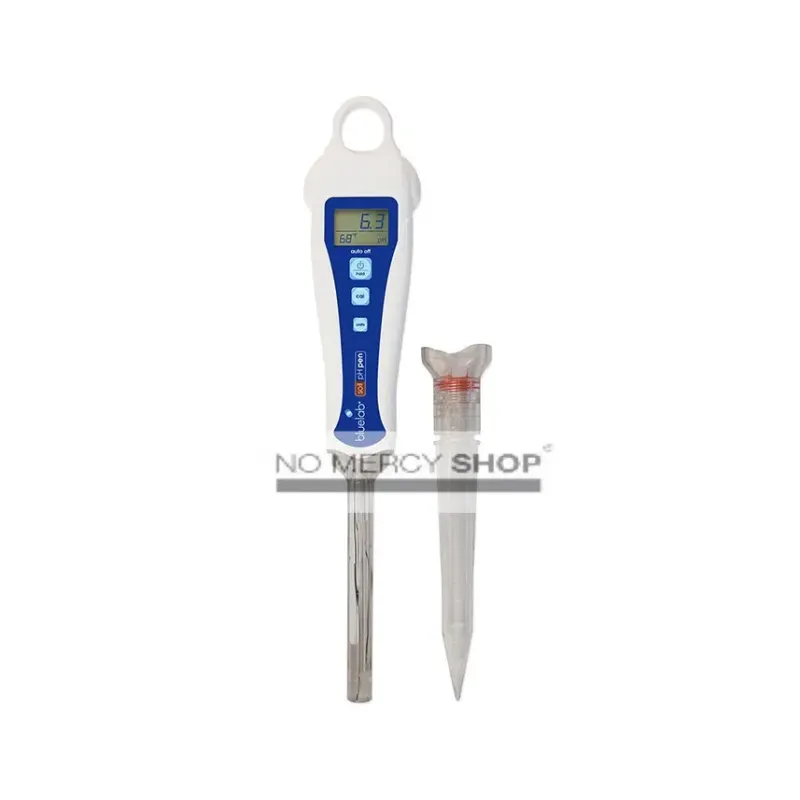
BlueLab pH Soil pen
A waterproof pen reading the pH of potting soil, not just of the solution.
- Bluelab
- Model: 84.042
- EAN: 9421024920487

QUALITY

PAYMENT

SHIPPING

PACKAGED
Carefully selected products.
Fast and secure checkout experience.
EU-wide delivery from trusted stock.
Carefully and discreetly packaged.
A pH pen with a tip you push straight into potting mix. It reads what is happening in the root zone, not what was in your watering can.
The Bluelab Soil pH Pen measures acidity where the roots actually meet it: in the medium itself. Range 0.0 to 14.0 pH, accuracy 0.1, with temperature measurement and automatic temperature compensation. Waterproof, and calibrated at two points.
Why your medium tells you something different from your feed water
This is the difference most growers only discover once something has already gone wrong.
You mix your feed at 6.0, you water, and you assume your plants are sitting in solution at 6.0. That is true at the moment of watering and not afterwards. What happens in the pot is its own process: the plant takes up some ions selectively and excretes others, lime in your soil or your tap water pushes acidity upwards, and leftover salts accumulate between waterings.
The result is that pH in the pot slowly drifts away from what you poured in. Usually upwards, towards 7, precisely the region where iron becomes unreachable. You water carefully at 6.0, you measure a tidy 6.0 in the bucket, and your roots are still sitting in something else entirely.
A solution meter never shows you this. What it measures is what you just mixed: a check on your own action, not on your plant.
Measuring in soil, coco and rockwool
The pen goes straight into moist medium. A few practical points separate a usable number from noise:
- Measure in moist medium. An electrode needs moisture to work. Bone-dry soil gives no reliable reading; measure shortly after watering, when the medium is damp through but not saturated.
- Measure at root level, not just under the surface. The top of the pot reads differently from where the root mass sits.
- Do not measure right next to a dripper. There you are reading fresh feed water rather than the pot.
- Take several readings if something looks odd. One outlier can be an air pocket; three matching readings are a pattern.
- Rinse the tip between pots with clean water so you do not carry medium from one into the next.
Rockwool is the easiest to read, coco next, soil the hardest: the coarser and airier the medium, the more you need to watch for good contact between tip and substrate.
Technical Specifications:
- pH range: 0.0 to 14.0 pH
- Resolution: 0.1 pH
- Accuracy: ± 0.1 pH
- Calibration points: 2. PH 4 and 7, or 7 and 10
- Temperature measurement: accurate to 1 °C
- Temperature compensation: automatic
- Build: waterproof
- Battery: 1 x AAA alkaline
- Warranty: 1 year
Frequently asked questions
Can I also measure my nutrient solution with it?
Yes, the pen reads liquid perfectly well. It does not work the other way round: an ordinary pH pen cannot be pushed into a medium.
What value should I aim for in soil?
Around 6.0 to 6.5 is normal for soil; in coco and rockwool you work lower, towards 5.5 to 6.2. More important than the exact figure is the movement: if your pot climbs further every week, something structural is behind it.
What do I do if the pot reads too high?
Correct your feed water downwards and water with a little more runoff so you carry accumulated salts away. If it keeps coming back, look at the hardness of your tap water, that is usually the cause.
Does the tip need to be stored wet?
Yes. As with any pH electrode the membrane has to stay hydrated. Store it with KCl storage solution in the cap.
Won't the tip clog with soil?
Rinsing with clean water after use is enough. Do not use a brush or any abrasive on the membrane, that is the part doing the measuring.

across Europe

Top brands

across Europe
Top brands