

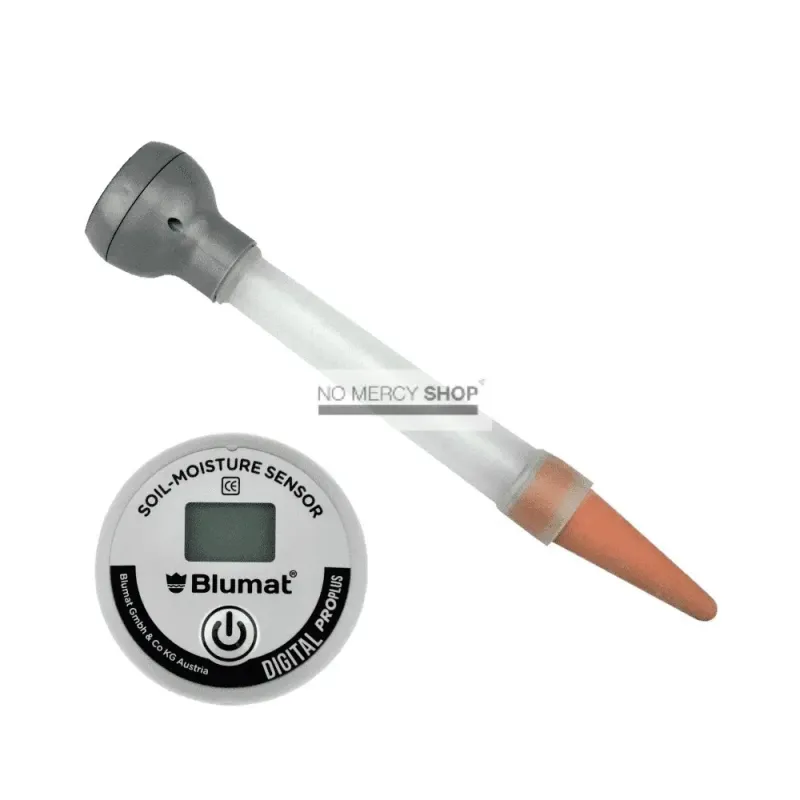
Blumat Digital Tensiometer
A tensiometer that tells you when to water, rather than watering on a schedule.
- Blumat
- Model: 203

QUALITY

PAYMENT

SHIPPING

PACKAGED
Carefully selected products.
Fast and secure checkout experience.
EU-wide delivery from trusted stock.
Carefully and discreetly packaged.
Measures how hard your plants have to pull to reach water. Works in soil, coco, peat mixes and open ground, with no recalibration per medium.
Every grower has done it: a finger in the pot, a quick feel, a shrug, and water anyway. Or lifting the pot and deciding it feels light. That works fine, until it does not. Too much water means oxygen starvation at the roots and an invitation to root rot; too little means stress and stalled growth. With both, you see the damage on the leaves days later.
The Blumat Digital Tensiometer takes the guesswork out.
What a tensiometer measures, and why that is different
This is the heart of it, and exactly where a tensiometer parts company with the cheap moisture probes.
Those probes measure electrical conductivity between two metal pins. That reading depends on your salt level, your feed and your substrate. Which is why the same meter reads completely differently in coco than in soil, and why it drifts as your EC climbs.
A tensiometer measures something else: moisture tension, meaning how hard your plant's roots have to pull to get water out of the substrate. That is not a proxy and not an approximation. It is literally how the plant experiences thirst, expressed as a number.
Because it measures suction rather than conductivity, one tensiometer behaves the same way in potting soil, coco, peat mixes and open ground. No separate table per substrate, no noise from your feed schedule.
How it works
Inside the meter is a water-filled porous ceramic cone. As the substrate around it dries, water is drawn out through the ceramic wall. Exactly as roots draw it from the surrounding medium. That outflow creates negative pressure in the sealed body, and the meter shows that pressure on its display.
Wet substrate, little suction, low value. Drier substrate, more suction, higher value. As soon as you water, the ceramic draws moisture back in and the value falls.
This meter gives suction in millibar (mbar), across a measuring range of 10 to 750 mbar. If you meet values elsewhere in centibar or hectopascal, those measure the same thing: 1 cbar is 10 mbar and 10 hPa. So multiply a table given in cbar by ten to use it here.
Reading the meter
| Value | What it means | What to do |
|---|---|---|
| Below 30 mbar | Saturated, around field capacity | Do not water, let it drain |
| 30 to 60 mbar | Wet, plenty of moisture available | Leave it |
| 60 to 120 mbar | The ideal zone for most container growing | Leave it |
| 120 to 200 mbar | Drying out, roots working harder | Water soon |
| 200 mbar and above | Too dry for a pot | Water now |
Note that pots and open ground do not belong at the same value. Plants in a pot sit happiest around 80 to 120 mbar, while plants in open ground are perfectly comfortable at 150 to 250 mbar. A larger root zone bridges higher tension without difficulty.
Use this as a starting point and then learn your own values. Within a week or two you will know where your plants in your pots want to sit, and you will water on a number instead of a hunch.
Placing it in four steps
- Soak the ceramic cone in clean water before first use, so the pores are fully saturated.
- Fill the body with clean water. Distilled, or boiled and cooled, is ideal: it keeps scale out of the ceramic and holds less air.
- Place it at root level. Make a pilot hole, push the cone firmly in and press the substrate around it. Good contact between ceramic and medium is critical: an air gap produces nonsense readings.
- Keep it away from drippers and the pot rim. Put it where the roots are, not where the water lands first.
Give it a few hours to equilibrate before trusting the first reading. If you move it, wait again.
Keep the top dry
This is by far the most common way this meter dies, and it is not printed large on the box: the digital head is not waterproof. If you hand-water over the pot, or the meter lives outdoors, a protection cap is not a luxury. Do not seat that cap directly on the substrate though, as that traps humidity around the sensor.
Technical Specifications:
- Measures: moisture tension (suction) in the root zone
- Unit: millibar (mbar); 1 cbar = 10 mbar = 10 hPa
- Measuring range: 10 to 750 mbar
- Measuring depth: 19 cm
- Reading: digital display, value appears at the press of a button
- Principle: porous ceramic cone with a water-filled body and an electronic pressure sensor
- Media: potting soil, coco, peat mixes and open ground, with no recalibration
- Battery: 3V CR2032 button cell, included, with a low-battery indicator
- Filling: clean water, preferably distilled or boiled and cooled
- Note: the digital head is not waterproof
Frequently asked questions
Does it read in mbar or cbar?
Millibar. If you find a table in centibar, multiply those values by ten: 10 cbar is 100 mbar.
Does it work in coco?
Yes. Tension is tension: the value means the same thing whatever the medium. Your ideal zone may sit slightly differently in coco than in soil, which is precisely why you measure rather than assume.
Do I need one per pot?
Not necessarily. Most growers put one in a representative pot and water the whole group on that reading. If your plants differ a lot in size or position, a second removes the doubt.
It reads 0, is that right?
Probably not. Zero usually means air in the body: check the water level and top it up.
What if it responds slowly?
The ceramic is probably clogged. Clean it gently, never with detergent or a wire brush.
Which battery does it take?
A 3V CR2032 button cell, the same as in many car keys and kitchen scales. You can buy one in any supermarket or chemist, so there is nothing to order.
Can it stay outside in winter?
No. Bring it in before it freezes; water expands as it freezes and the ceramic does not survive that.

across Europe

Top brands

across Europe
Top brands