

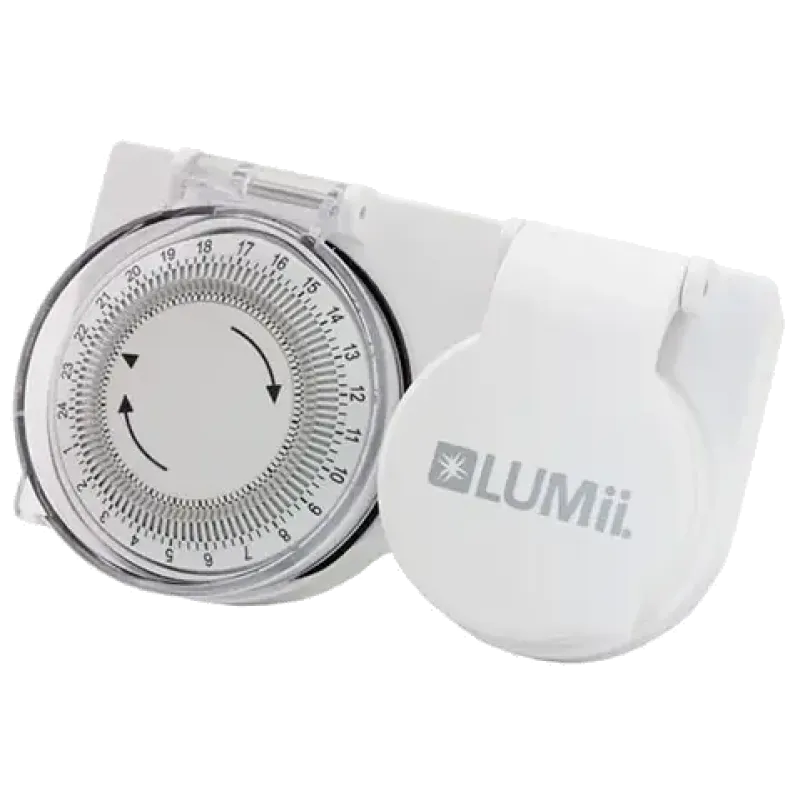
LUMii Heavy Duty Timer
An analogue timer with heavy duty contacts, built for the switch-on surge of an LED fixture.
- Model: LUMIIhdt

QUALITY

PAYMENT

SHIPPING

PACKAGED
Carefully selected products.
Fast and secure checkout experience.
EU-wide delivery from trusted stock.
Carefully and discreetly packaged.
An analogue 24 hour timer with heavy duty contacts, built for the hardest moment you switch in a grow room: the surge your light draws as it comes on. For a single LED fixture this is the simplest and cheapest way to run your light schedule, with no contactor in between.
How a cheap timer fails, and which way it fails
Inside every timer sit two metal contacts that meet when the light is due to come on. In the instant before they touch, current jumps the last of the gap. On a table lamp you never notice. On grow lighting that jump is fierce enough to burn a little off the contact face every single time.
What happens next is the whole point of this page, and it is not what most people expect. A timer that gives up under a lighting load does not switch off, it welds shut. The contacts fuse together and the dial keeps turning, it simply never breaks the circuit again. LUMii put it in exactly those terms in their own product information: the contacts of an ordinary household timer overheat, weld together, and leave your lights permanently on. They wrote that about ballasts, but a contact has no idea what kind of lamp is behind it: it only knows how hard it is made to switch, every day.
Permanent light during flowering means no flowering. And since the lamp is lit, most growers find out only when they walk in at an hour that should have been dark.
The number printed on the box is a resistive rating
Nearly every timer carries a wattage, and that figure describes a heater: a resistance drawing exactly the current Ohm's law says it should, from the first millisecond onwards. An LED fixture behaves nothing like that.
Every LED fixture has a driver, and a driver starts with a substantial capacitor that is empty at switch-on. An empty capacitor briefly behaves like a short circuit. Never long enough to trip your breaker, but every single day it is hard enough to gnaw at a contact face.
For the HLG-240H, a 240 watt LED driver, Mean Well publish an input current of 1.3 amps at 230 volts and a cold start peak of 75 amps lasting 570 microseconds. That is roughly sixty times the running current, over faster than a blink, and no meter you own will show it to you. On paper you have hung a lamp of less than one and a half amps on your timer. In reality that contact takes a seventy-five amp hit every morning.
Mean Well themselves say how much it matters: a single 16 amp type B breaker will carry two of those drivers. Not because they draw too much together, but because they start too hard together.
That is the difference between this timer and one costing a few euros. Switching a single LED fixture is exactly what heavy duty contacts are for. Put several fixtures behind it and those peaks stack, because they all start on the same hundredth of a second. Past that point a relay box belongs in between, with the timer driving that rather than the lamps. We stock those as the Cli-mate Mini-controller with two or four 600 watt lamp contacts. If you would rather not add a box, the other route works just as well: give each lamp its own LUMii.
Where those heavy contacts came from
This timer was designed when every grow room ran a ballast, and LUMii still rate it for one 600 watt ballast today. A coil holds current flowing at the instant you switch off, and that energy pulls an arc between the contacts as they part.
For an LED grower that history is not a piece of trivia, it is the reason to choose this timer. The contact was built around the heaviest lighting load of its era, and that is precisely the margin a household timer does not have. Keep your fixture under that 600 watts and you sit comfortably inside the current this contact was designed for. Nobody publishes a figure for a driver's inrush, LUMii included, which is why the advice above reads as it does: one fixture direct, more than one through a relay box or through a timer of its own per fixture.
Why a dial rather than a display
Ninety-six pins run around the dial, one per quarter hour. Pushed down is on, pulled up is off. That is the entire interface.
The real benefit shows up when you want to check something. Your schedule is not a setting stored in a memory somewhere, it is the position of 96 pins that you can read from across the room. One look tells you when the light comes on, when it goes off, and whether a stray second block has been left switched in.
That is what a digital timer makes hard. A leftover programme, an on and an off the wrong way round, or a weekday left out all look identical on the display to a correct setting. You discover it when it switches, or fails to. On a dial a mistake has nowhere to hide.
Two things an analogue timer cannot do, and you should know both before choosing. It will not set finer than a quarter of an hour, so for short irrigation cycles of a few minutes it is the wrong tool. And it runs on mains power: after an outage the dial has stood still and the clock is then permanently behind, so check the pointer once the power is back.
Technical Specifications:
- Type: analogue 24 hour segment timer
- Interval: 15 minutes per segment
- Switching points: 96 per day
- Our advice with LED: connect a single fixture directly
- Several fixtures: through a relay box driven by this timer, or one timer per fixture
- Capacity per LUMii: one 600 W ballast
- Build: inline case with dust covers on plug and timer
- Use: indoors, dry
Frequently asked questions
Can I run my LED light from it?
Yes, and that is what it is mostly used for now. Connect a single fixture directly. To switch several lamps at once there are two routes: a relay box in between, the Cli-mate Mini-controller for instance, with this timer driving it, or simply one LUMii per fixture. The start-up peaks of multiple drivers land at the same instant and add up.
Why is there no wattage for the timer itself in the specifications?
Because LUMii do not publish one and the figures circulating at retailers contradict each other. What the manufacturer does state is the load that matters: one 600 W ballast, or six 200 W CFLs. A wattage on a timer describes a resistive load and says little about a lamp.
How does it differ from the Fertraso timer you also sell?
The Fertraso is an ordinary household timer with half hour segments, fine for a fan, a pump or a heating mat. This LUMii has heavier contacts and is meant to have a lamp on it.
Does my schedule survive a power cut?
Yes. The pins stay where you put them, because no memory is involved. Only the clock itself falls behind, so reset the pointer to the right time after an outage.

across Europe

Top brands

across Europe
Top brands