

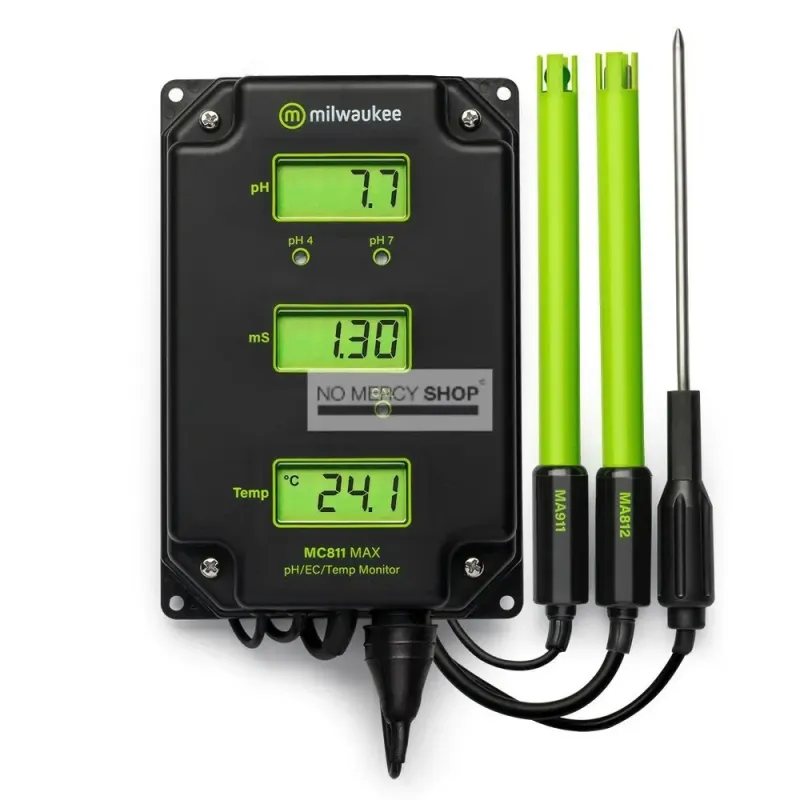
Milwaukee MC811 Max 3-in-1(pH,EC en temp)
pH, EC and temperature in one monitor, affordable and made in Europe.
- Milwaukee
- Model: 4356
- EAN: 5999567671738

QUALITY

PAYMENT

SHIPPING

PACKAGED
Carefully selected products.
Fast and secure checkout experience.
EU-wide delivery from trusted stock.
Carefully and discreetly packaged.
Continuous monitor with three backlit displays: pH, EC and temperature, all visible at once. Developed and built in Europe.
The Milwaukee MC811 Max lives permanently in your nutrient reservoir and measures day and night. Three separate backlit displays mean you see all three values at a glance, with nothing to switch or scroll through. Calibration is by three trimmers: two-point for pH (4.01 and 7.01) and single-point for EC.
Accuracy is ± 0.2 pH, ± 2% on EC and ± 0.3 °C. Supplied with a mounting kit, electrode holder and the MA911B/2 gel-filled double-junction pH electrode. All three electrodes carry two metres of cable, and the monitor runs on a 12V supply.
Reading pH and EC as a pair, not as separate numbers
The reason to see pH and EC in one place is that together they tell you something neither can alone. A single reading says almost nothing: it is the movement across days, and the combination of both, that tells you what your plants are doing.
Start with the mechanism: a plant does not take up water and nutrient in the same ratio. From that follow the two cases you see most often:
- EC rising. Proportionally more water is leaving the reservoir than salt, so what remains gets more concentrated. Top up with water at a lower EC than your target: not full-strength feed, which stacks it up.
- EC falling. The plants are taking nutrient faster than water. Adding feed is fine, but measure again afterwards.
And then the combination most worth knowing: a sudden jump in pH while EC barely moves. That is rarely a nutrient problem. More often it is the root zone. Dying root tissue releases compounds that shift acidity, and it does so before anything shows above ground. If you see that pattern, look at your roots and your water temperature before you start adjusting your schedule.
Which is exactly why a monitor showing all three at once is more than three separate meters on one board. The temperature sits right beside them, and warm water is the usual cause behind a root problem you first notice as a pH problem.
Maintenance: the two sensors differ
The pH electrode and the EC sensor do not age the same way, and that is useful to know.
The pH electrode is a consumable with a limited life; it slowly gets sluggish and drifts from its calibration value. Always store it with buffer or KCl storage solution in the rubber cap, never with tap or deionised water.
The EC sensor is considerably more robust and lasts a long time. Its problem is not age but fouling: salts and biofilm on the sensor push the reading off. Dipping it in cleaning solution regularly sorts that out. Always recalibrate after cleaning, and stir the electrode gently through the solution for a faster, steadier reading.
Technical Specifications:
- pH range: 0.0 to 12.0 pH
- resolution: 0.1 pH
- accuracy: ± 0.2 pH
- EC range: 0.00 to 5.00 mS/cm
- resolution: 0.01 mS/cm
- accuracy: ± 2% of full scale
- Temperature range: -10.0 to 60.0 °C
- resolution: 0.1 °C
- accuracy: ± 0.3 °C
- Calibration: pH manual two-point (4 and 7), EC manual single-point, via trimmers
- Electrode: MA911B/2, gel-filled, double junction
- Cables: 2 metres on all three electrodes
- Power: 12V DC
- Supplied with: mounting kit and electrode holder
Frequently asked questions
Can it correct or dose by itself?
No, the MC811 measures and displays. Correcting is up to you.
Is ± 0.2 pH accurate enough for a monitor?
For the purpose, yes. A monitor exists to show movement and excursions; for fine adjustment you use a handheld. That is a sensible division of labour rather than a shortcoming.
Why only one calibration point for EC?
Because a conductivity sensor is far more linear than a pH electrode. One reference point is enough there, where pH needs two.
Can the electrodes stay in the solution permanently?
Yes, that is what the monitor is built for. Continuous use does shorten the pH electrode's life. Expect to replace it once calibration no longer holds.
Why a range to 12 pH rather than 14?
Because that is the range this monitor belongs in. For nutrient reservoirs, growing systems and aquaria you measure well inside it.

across Europe

Top brands

across Europe
Top brands