

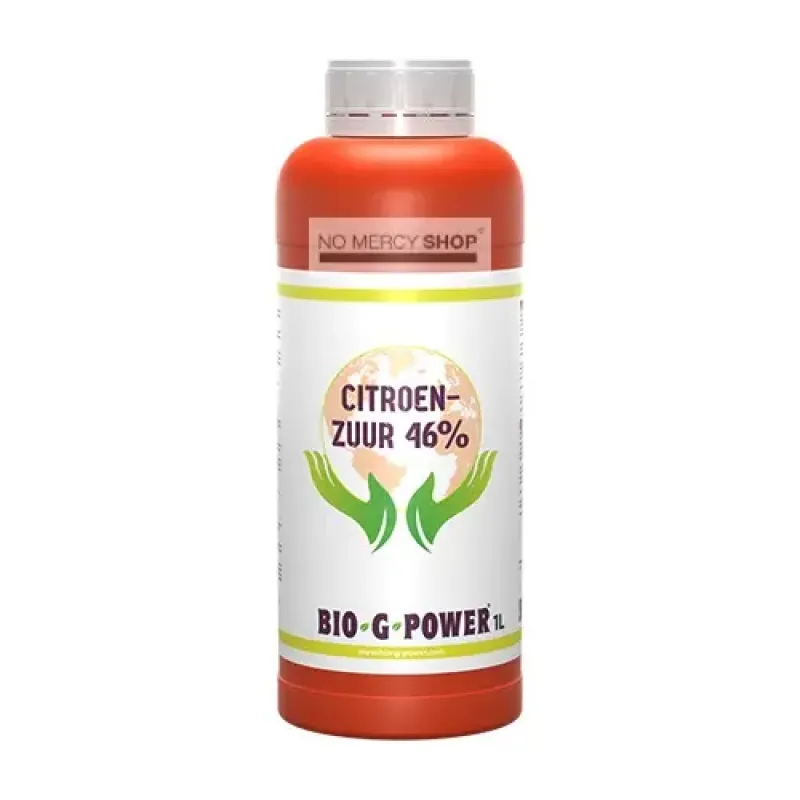
Bio G Power - Citric Acid 46% 1 liter
46% citric acid: curbs plant-pathogenic bacteria and stimulates the energy carriers.
- Bio G Power
- Model: 11.548

QUALITY

PAYMENT

SHIPPING

PACKAGED
Carefully selected products.
Fast and secure checkout experience.
EU-wide delivery from trusted stock.
Carefully and discreetly packaged.
An organic pH reducer based on 46% citric acid. Besides acidifying your nutrient water, this is also what you reach for to clear limescale from lines and drippers.
Citric acid is a chelator, and that is where the second function comes from
What sets citric acid apart from phosphoric or nitric acid is not only that it is organic. It is that the molecule can wrap around metal ions and hold on to them. That is called chelation, and it is exactly the same property that makes citric acid the household choice for descaling kettles and shower heads.
The same thing happens in a grow setup. Limescale, iron precipitate and the hard white deposit that builds up in drippers and narrow lines are metal salts that dropped out of solution as pH climbed. Citric acid binds those ions again and pulls them back into solution, after which they simply travel out with the water.
That makes this bottle useful in two ways few products on this shelf combine. As a daily pH reducer it keeps your waterways clear while doing its actual job. And when you flush a system between two cycles, a more strongly acidified flush is a simple way to open up blocked drippers without taking them apart.
Why it behaves differently from a mineral acid during a flush
At the end of a cycle many growers flush their medium to wash out accumulated salts. A mineral acid only helps so far with that: phosphoric acid adds phosphate of its own to a pot you are trying to get salt out of.
Citric acid adds neither nitrogen nor phosphorus. What it does do is loosen the bound metal salts in the substrate so they can leave with the flush water. For that particular job an organic acid is the more logical choice than a mineral one, and that is a reason to keep this bottle in the cupboard quite apart from pH correction.
It is a weak acid, so you need more of it
Citric acid only partly releases its hydrogen ions in water. That means you need more of it per litre of reservoir than of a concentrated mineral acid, and that the drop in pH is more gradual.
When dosing, that is actually pleasant: you are less likely to shoot past your target than with a strong mineral acid, where one drop too many shows up immediately. Do factor into any price comparison that a bottle of this runs out faster.
The flip side is the same as with any organic acid: it is biodegradable, so bacteria in a standing reservoir consume it and the pH creeps back up. Measure more often than you would with a mineral acid, and refresh a reservoir that has stood for a while rather than repeatedly correcting it.
In use
Set your EC with your nutrients first. Then add the citric acid in small quantities, stirring while you measure, and repeat until you reach the pH you want. Bio G Power state explicitly that you adjust pH only after your EC value has been set.
Avoid contact with skin and eyes, organic basis notwithstanding. Consult a doctor if irritation of the skin or eyes persists. Store the bottle upright and dark, above five degrees, out of reach of children.
Technical Specifications:
- Type: organic pH reducer, liquid concentrate
- Manufacturer: Bio G Power
- Composition: 46% citric acid
- EC number: 201-069-1
- Adds: no nitrogen and no phosphorus
- Second function: chelates metal ions, dissolves lime and salt deposits in lines and drippers
- Phase: the whole cycle, including the flush
- Dosage: add in small quantities and measure while stirring, only once the EC has been set
- Volume: 1 litre
- Storage temperature: minimum 5 °C
- Safety: avoid contact with skin, eyes and clothing, consult a doctor if irritation persists
Frequently asked questions
Why choose this over a phosphoric acid product?
Two reasons: it adds no phosphate or nitrate to your solution, and it keeps your lines and drippers clear instead of letting deposits form.
Can I flush a blocked drip system with it?
Yes. Citric acid binds the metal salts those deposits are made of and pulls them back into solution. An acidified flush between two cycles is the natural application.
Why does a bottle of this run out faster?
Citric acid is a weak acid and only partly releases its hydrogen ions, so you need more per reservoir than of a concentrated mineral acid.
Why does my pH creep back up?
Because it is biodegradable and gets broken down by bacteria in a standing reservoir. The warmer the tank, the faster. Measure more often and refresh in good time.
Is it suitable for organic growing?
Yes. An organic acid leaves soil life alone where a mineral acid does not, and it does not shift your NPK ratios.

across Europe

Top brands

across Europe
Top brands