

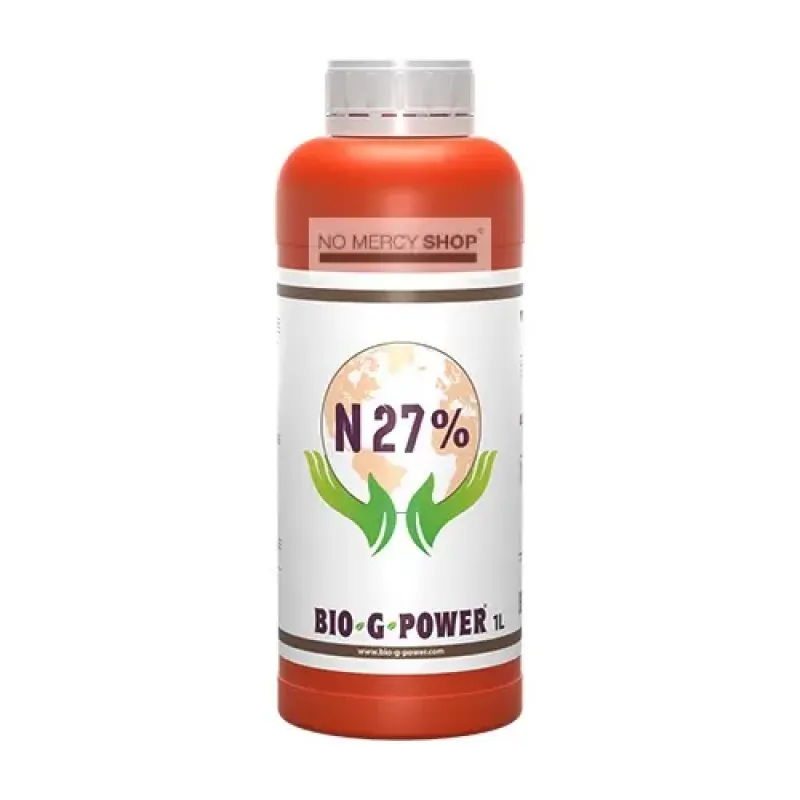
Bio G Power - N 27% Nitrogen Additive
27% nitrogen in three forms, for severe shortages only. 50 to a maximum of 250 ml per 100 litres.
- Bio G Power
- Model: 11.564

QUALITY

PAYMENT

SHIPPING

PACKAGED
Carefully selected products.
Fast and secure checkout experience.
EU-wide delivery from trusted stock.
Carefully and discreetly packaged.
A mineral nitrogen fertiliser at 27% nitrogen. Bio G Power attach one instruction that governs everything else: use only for severe nitrogen deficiencies.
This is an emergency bottle, not a schedule bottle
Start with the manufacturer's instruction, because it is there for a reason. Bio G Power write that you should use this product only for severe nitrogen shortages.
That places it outside your regular feeding schedule. You do not add this weekly because you own it; you reach for it when your crop is yellowing from the bottom up and you have established that nitrogen is the cause. For building a schedule you buy a base feed or a growth booster.
The dose reflects that: 50 ml up to a maximum of 250 ml per 100 litres of water. A fivefold range with an explicit ceiling is the shape of a correction, not of a routine.
Three forms of nitrogen, and three speeds
The 27% is not one kind of nitrogen. Bio G Power break it out: 8% ammonium nitrogen, 9% nitrate nitrogen and 10% amide nitrogen.
That difference is exactly why this bottle works as a rescue. The three forms do not become available at the same time.
- Nitrate nitrogen is immediately available. The plant can reach it at once, which is what you want when repairing a shortage.
- Ammonium nitrogen is taken up faster than nitrate but has to be converted inside the plant, and too much of it acidifies the root zone.
- Amide nitrogen is the slowest. It has to be converted to ammonium and then to nitrate before anything happens with it.
So you get a fast correction and a tail that keeps running afterwards. One feed builds a reserve that a pure nitrate product would have sent you back for.
It also explains why overdosing here is not free. The slow-release part is still there when you decide the first feed was not enough.
There is calcium and magnesium in it too
The product also contains 1.9% calcium and 1.6% magnesium. Modest figures, but not meaningless: at a nitrogen feed of this size, calcium displacement is a real risk, and this covers part of it.
Where nitrogen sits in the plant
Bio G Power sum it up briefly and it is worth remembering why a shortage looks the way it does: nitrogen is among other things the building block of proteins, so of amino acids, and of chlorophyll.
Chlorophyll is why a nitrogen shortage starts with yellowing, and why that yellowing starts low down: the plant breaks chlorophyll down in old leaf to move the nitrogen to new leaf. What you see is not a loss but a relocation, and it stops as soon as you clear the shortage.
In use
Mix 50 ml up to a maximum of 250 ml per 100 litres of water. Start at the bottom of that range and judge the result before raising it, precisely because of the slow-release fraction.
Store the bottle above 5 degrees Celsius and out of reach of children.
Available sizes
| Size | Price |
|---|---|
| 1 liter | € 8.75 |
| 5 liter | € 40.95 |
Technical Specifications:
- Type: mineral nitrogen fertiliser, corrective
- Manufacturer: Bio G Power
- Nitrogen: 27% total
- Of which ammonium: 8%
- Of which nitrate: 9%
- Of which amide: 10%
- Calcium: 1.9%
- Magnesium: 1.6%
- Dosage: 50 to a maximum of 250 ml per 100 litres of water
- Application: only for severe nitrogen deficiencies
- Storage: not below 5 degrees Celsius
Frequently asked questions
Can I build this into my regular schedule?
Bio G Power advise against it. They prescribe this product explicitly for severe nitrogen shortages rather than as a routine feed.
What is the difference between those three forms?
Nitrate is immediately available, ammonium has to be converted inside the plant, and amide is the slowest of the three. Together they give a fast correction with a longer tail.
I have fed it and see nothing yet. Give more?
Wait first. Part of the nitrogen releases slowly, so what you add now stacks on what has yet to come free.
Why is my leaf yellowing from the bottom?
Because under a nitrogen shortage the plant breaks chlorophyll down in old leaf to move it into new leaf.
Is there anything else in it?
Yes, 1.9% calcium and 1.6% magnesium.

across Europe

Top brands

across Europe
Top brands