

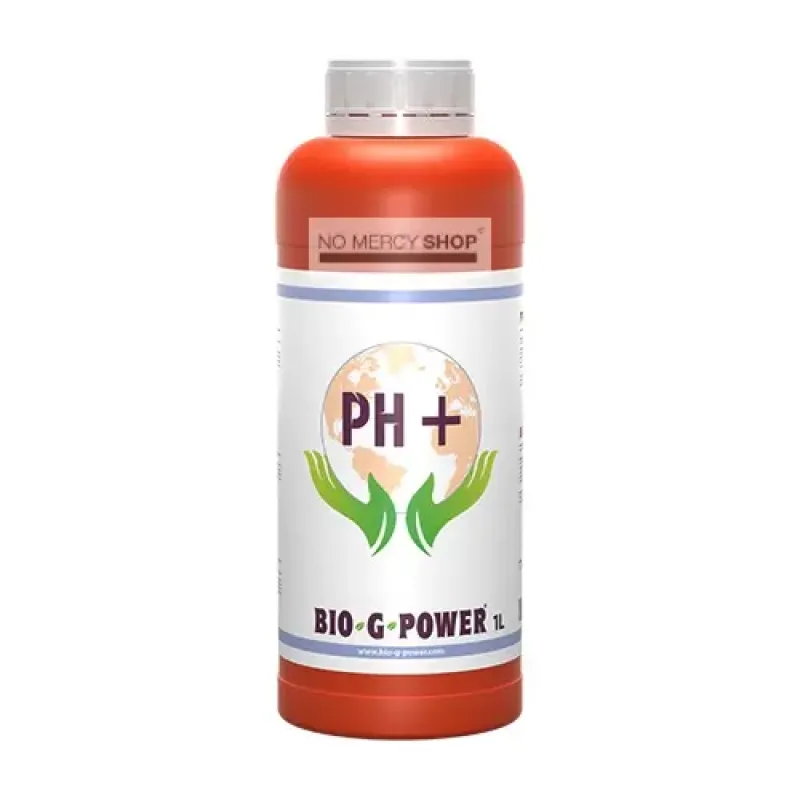
Bio G Power - pH Plus
pH up, for when the solution has dropped too far.
- Bio G Power
- Model: 11.559

QUALITY

PAYMENT

SHIPPING

PACKAGED
Carefully selected products.
Fast and secure checkout experience.
EU-wide delivery from trusted stock.
Carefully and discreetly packaged.
A concentrated alkaline pH regulator based on potassium hydroxide, for raising the pH of your nutrient solution. Recommended value 5.5 to 6.3. Available in 500 ml and 1 litre.
An alkali burn behaves differently from an acid burn
Nearly every pH regulator product page carries the same line: wear gloves and goggles. What is rarely added is that a strong base is dangerous in a different way from a strong acid, and that the difference lies exactly in what you notice.
An acid on your skin stings immediately. That is unpleasant and it is also your warning: you rinse straight away. A strong base does not do that. Potassium hydroxide feels slippery at first, as though you have soap on your fingers, and that is literally what is happening: the base is reacting with the fats in your skin. That slipperiness is not a nuisance but the sign that the reaction is already running, and pain often arrives later.
The same applies to eye contact with larger consequences, because a base penetrates deeper into tissue than a comparable acid rather than stopping at the surface. That is why the safety instruction for products like this is not a quick rinse but prolonged rinsing, and with eyes, continuing to rinse while you arrange medical help.
In practice it comes down to this. Work over a low, stable surface, use a dedicated measuring jug you use for nothing else, rinse immediately and at length on any contact, and take off contaminated clothing rather than trying to wash it out. None of this is dramatic; it is why the bottle carries a warning label rather than a set of instructions.
What potassium hydroxide does to your nutrient solution
Potassium hydroxide splits in water into hydroxide ions and potassium ions. The hydroxide ions mop up the free hydrogen ions and the pH rises. The potassium ions stay behind and are simply plant food: potassium is the K in NPK.
That makes a pH raiser less disruptive to your schedule than a pH reducer. Where an acid shifts your phosphate or your nitrate, and can therefore work against you in the wrong phase, a base adds potassium, which the plant wants from start to finish. Your EC does climb slightly, so set your EC with your nutrients and correct the pH afterwards.
Dosing
Bio G Power keep it simple: add as needed, stir well, and always measure the pH. The recommended value they give runs from 5.5 to 6.3.
Do it in small steps. A concentrated base acts faster than your meter responds, and anyone tipping in a splash overshoots and then corrects back with acid. That back and forth costs nothing in pH but does lift your EC, because both bottles leave ions behind. Stir the reservoir right through before measuring, or you will read one spot in the tank rather than the average.
Size and weight
This pH Plus comes in 500 ml and 1 litre. Bio G Power give net weights of 680 grams and 1285 grams for those. Store the bottle upright, above five degrees and out of reach of children, in its original packaging. A concentrated base does not belong in an unmarked bottle and certainly not in anything that once held a drink.
Available sizes
| Size | Price |
|---|---|
| 500 ml | € 4.95 |
| 1 liter | € 8.95 |
Technical Specifications:
- Type: alkaline pH regulator, liquid concentrate
- Manufacturer: Bio G Power
- Composition: potassium hydroxide (KOH)
- Adds: potassium
- Application: soil, coco, hydro and aeroponics, vegetative and flowering
- Recommended pH: 5.5 to 6.3
- Dosage: as needed in small steps, stir well and always measure
- Net weight: 680 g at 0.5 litre, 1285 g at 1 litre
- Storage temperature: minimum 5 °C
- Hazards: causes severe burns and eye damage
- Storage: keep only in the original container, upright, out of reach of children
Frequently asked questions
Is a base more dangerous than an acid?
Differently dangerous. An acid stings at once and warns you. A base feels slippery first and penetrates deeper, so rinse at length with plenty of water on any contact and seek medical help for eye contact.
Why does it feel slippery on my fingers?
Because the base is reacting with the fats in your skin. That is not a harmless property but the sign the reaction is running. Rinse immediately and at length.
Does it change my feed schedule?
It adds potassium, which the plant wants in both phases, so it is far less disruptive than a pH reducer. Do set your EC with your nutrients and correct the pH afterwards.
How much should I dose?
There is no fixed amount. It depends on your water quality and nutrient concentration. Add as needed, stir, measure, repeat.
Can I decant it into another bottle?
No. Keep it in the original container with its label. A concentrated base in an unmarked bottle is exactly how accidents happen.

across Europe

Top brands

across Europe
Top brands