

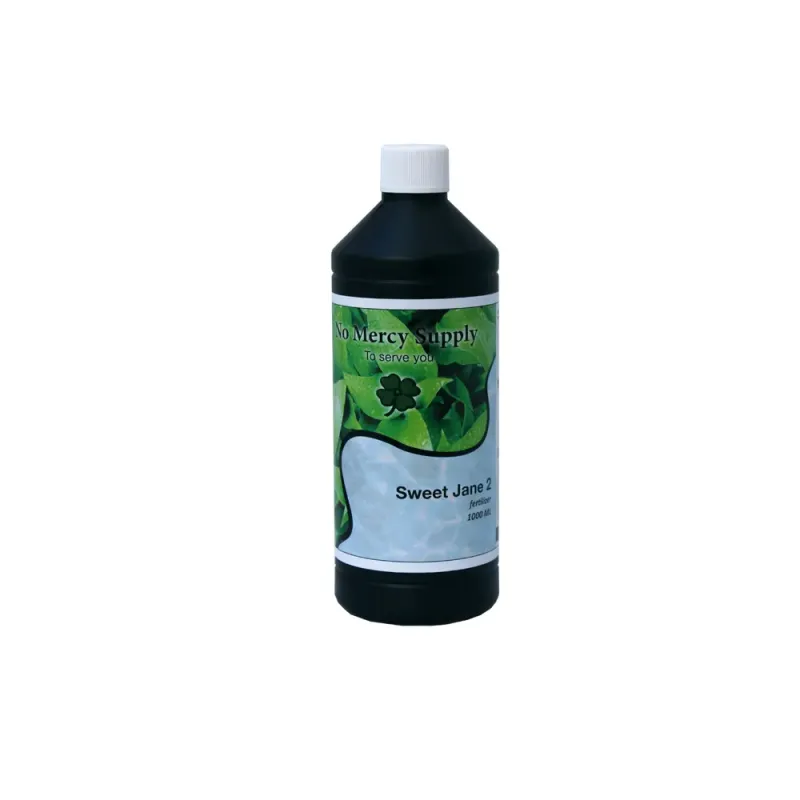
No Mercy Supply - Sweet Jane 2
Bio-mineral base feed at NPK 2-4-9 for the second half of the cycle. Maximum 10 ml in 2 litres of water.
- No Mercy Supply
- Model: 113

QUALITY

PAYMENT

SHIPPING

PACKAGED
Carefully selected products.
Fast and secure checkout experience.
EU-wide delivery from trusted stock.
Carefully and discreetly packaged.
A bio-mineral base feed at NPK 2-4-9, for the rest of the cycle from phase 2 of fruiting onward. A maximum of 10 ml in 2 litres of water for mature plants.
From 7-7-7 to 2-4-9: the nitrogen comes out
Put the two bottles side by side and the story tells itself. Sweet Jane 1 sits at 7-7-7. Sweet Jane 2 sits at 2-4-9. Nitrogen drops from 7 to 2, phosphorus from 7 to 4, and potassium climbs from 7 to 9.
That is not a shift in emphasis but a reversal. In the second half of the cycle the plant is no longer adding leaf and structure; it is filling out what is already there. Nitrogen given at that point goes into foliage you no longer need, and it comes at the expense of the quality of what you do want.
Potassium at 9 is the counterpart: it is the element of ripening, of water regulation, and of moving sugars to where they have to end up.
Leaving nothing behind is the design goal
No Mercy built this line explicitly on the idea that nutritional demand during flowering, fruiting and ripening is not equal, and that one bottle does not follow that curve neatly.
The point of two bottles is not only that the plant lacks nothing, but that nothing is left over. Nutrients left behind in the soil cause accumulations, and accumulations cause blockages: elements crowding each other out and producing deficiencies while plenty is present.
That is also why there is a separate second bottle rather than simply a lower dose of the first. Giving less 7-7-7 lowers everything at once, including the potassium you actually need more of.
The transition week
You do not have to switch from one watering to the next. No Mercy state that Sweet Jane 1 and 2 may be mixed during the transition week for a smooth handover.
In practice it works best to shift the ratio across that week rather than flipping halfway: start mostly 1, end mostly 2, and steer on your EC throughout.
How the EC runs after that
From internode 10 the schedule lets the EC climb gradually: up 0.1 every four days, to 1.8. After you have fed at EC 1.8 twice, you bring it back down at the same pace to 1.6.
Towards the end you raise the pH slowly to about 6.4. If you are going to reuse the medium, you bring it gently back to 6.0 while flushing.
If you are adding Bloom Sensation, that goes in first and you then bring the EC to target with Sweet Jane 2.
In use
The recommended dose is a maximum of 10 millilitres in 2 litres of water for mature plants, at every watering. For plants under 30 centimetres, halve it, though you rarely meet that size at this stage of the cycle.
As in Sweet Jane 1, the trace elements are chelated, with the iron bound to Fe-EDDHA. Use an EC meter when mixing.
Available sizes
| Size | Price |
|---|---|
| 1 liter | € 10.95 |
| 10 liter | € 61.50 |
Technical Specifications:
- Type: bio-mineral liquid base feed
- Manufacturer: No Mercy Supply
- NPK: 2-4-9
- Trace elements: chelated, iron as Fe-EDDHA
- Dosage: maximum 10 ml in 2 litres of water, mature plants
- Frequency: every watering
- Period: from phase 2 of fruiting to the end
- Predecessor: Sweet Jane 1, with a transition week where mixing is allowed
- EC curve: up 0.1 every 4 days to 1.8, then back to 1.6
- pH: towards roughly 6.4 near the end
Frequently asked questions
Why not just give less Sweet Jane 1?
Because that lowers everything at once, including the potassium that should be going up at this stage. 2-4-9 is a different ratio, not a weaker one.
When do I switch over?
Around phase 2 of fruiting. During the transition week you may mix the two.
How high can my EC go?
The schedule climbs 0.1 every four days to 1.8, feeds at that value twice, then drops back to 1.6.
In what order do I mix?
Bloom Sensation first, then bring the EC to the target value with Sweet Jane 2.
Why does the pH go up at the end?
That is what the schedule calls for, towards about 6.4. If you reuse the medium you bring it back to 6.0 while flushing.

across Europe

Top brands

across Europe
Top brands