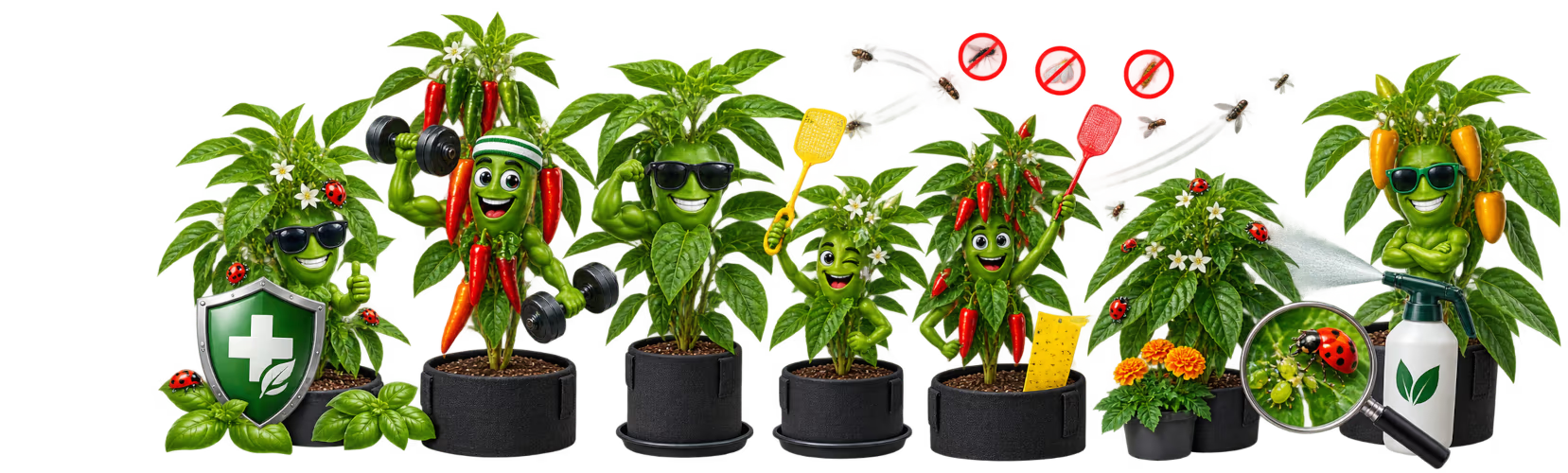
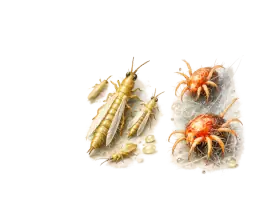
With plant health, almost everything you buy is cheaper than what it prevents. Spider mite, aphids, thrips and mildew spread through a warm, still room faster than you can clear them, and by the time you see them with the naked eye you are already behind. This category is small, and that is right: most of the gain is not in a bottle but in what you do beforehand.
You always see them later than they arrived
That is the core problem. A population builds invisibly on the underside of leaves and in the corners of the room, and what you eventually notice is damage rather than an insect. With spider mite you usually see fine stippling on the leaf first and webbing only later; with thrips, silvery streaks. By then several generations have passed.
That is what the sticky traps are for. They control nothing; they show you something has arrived before it becomes a problem, and that is exactly the week you need. Colour matters here: yellow catches broadly, blue is aimed mainly at thrips. Hang them at canopy height and actually check them, because a trap you do not read does nothing.
Your climate is the first treatment
Still, warm, humid air is precisely what pests and fungi need. Air movement between plants, not packing them too closely, and humidity that does not linger after lights-out do more together than any bottle. In that sense a circulation fan is also a mildew treatment.
Clean working belongs with it: tools wiped between plants, and no new cuttings dropped straight into a running grow. Most infestations come from somewhere, and usually that somewhere is something you carried in yourself.
What is here, and what it targets
The products under Diseases & Pests are chosen per target rather than as broad-spectrum cures. A.R.T.S. has separate products for spider mite, for flying insects, for thrips, for fungus and for root rot. Aptus Fungone addresses fungus and also comes as a concentrate. Canna Cannacure and Atami B'cuzz Bio Defence work through the leaf on the plant's own resilience, which is a different job from killing a pest.
That distinction is worth holding onto. A resilience product is used preventively and should not be expected to rescue an outbreak already under way. A targeted product is used once you know what you have, which means identifying it first. A microscope or loupe is the tool for that.
The label decides when, and whether
Read the label at the moment you apply, not only when buying. Many products may no longer be used once flowering has started, and a treatment applied at the wrong moment is worse than the problem it was meant to solve. The label also gives the dose, the interval and what it is approved for, and that is binding.
Practically: spray a fine mist and treat the underside of the leaf in particular, because that is where they sit. Do it at lights-out or just before, so droplets are not standing on leaves under a running lamp. A pressure sprayer gives a more even mist than a squeeze bottle, and it is worth keeping a separate one for treatments.
Frequently asked questions
How do I know I have spider mite?
Look at the underside of the leaf. Fine pale stippling on the upper surface is usually the first sign, and webbing between leaf tips only appears once the infestation is advanced. A loupe or microscope buys you a day or two.
Can I spray during flowering?
It varies by product and the label governs. Many are explicitly not approved once flowering is under way. Do not assume that something allowed in veg is allowed later.
Yellow or blue sticky traps?
Yellow catches most broadly and is the default for monitoring. Blue is aimed mainly at thrips. Hanging both tells you sooner which way things are going.
Should I treat if I cannot see anything?
Not with a pesticide. But this is the moment for the cheap measures: hang traps, sort out air movement and work cleanly. That is what prevention means here.
Is one treatment enough?
Usually not. Eggs and pupae survive a treatment that kills adults, so the pest returns as they hatch. The label states the interval for repeating, and that interval exists for exactly this reason.