

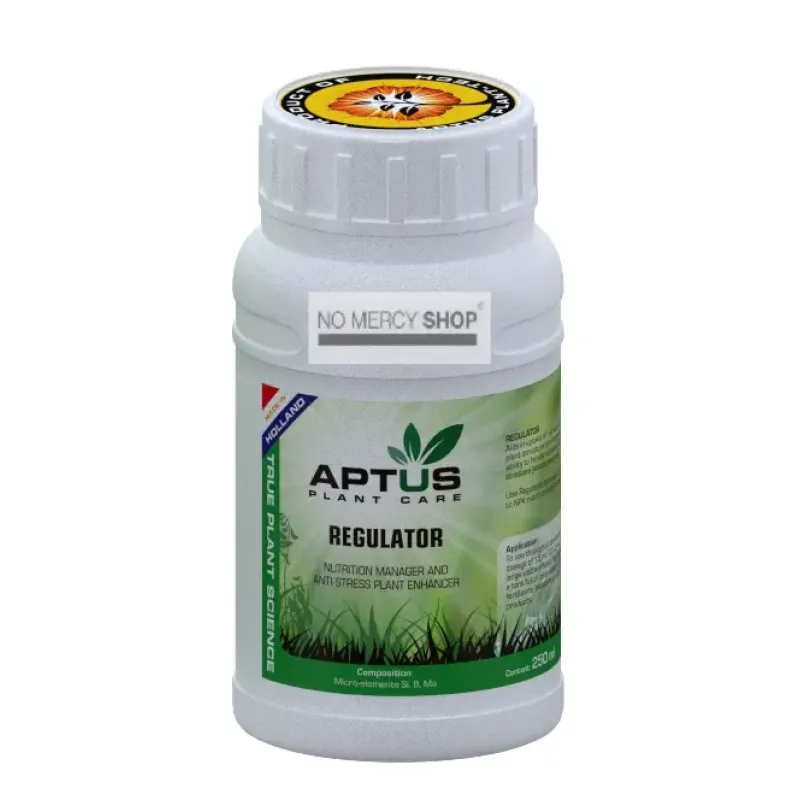
Aptus - Regulator
A nutrition manager based on mono-silicic acid, with boron and molybdenum. 15 ml per 100 litres, first into the tank.
- Aptus
- Model: f103200
- EAN:

QUALITY

PAYMENT

SHIPPING

PACKAGED
Carefully selected products.
Fast and secure checkout experience.
EU-wide delivery from trusted stock.
Carefully and discreetly packaged.
Mono-silicic acid with boron and molybdenum. 15 ml per 100 litres of water, mixed into clean water before anything else, right through the cycle.
Why this goes into the tank first
Aptus call Regulator a nutrition manager, and that word comes from somewhere. They work with an order in which plants take up nutrients, and that order does not start at nitrogen.
It starts at boron. Boron causes sugars to be released from the root system into the medium. Those sugars feed the microbes. The microbes convert silicates into silicic acid. The silicic acid raises calcium uptake. Only then come nitrogen in amino acid form, magnesium, phosphorus and potassium.
The point of that chain is that it behaves like a chain. If one link is not available, the uptake of everything after it is hindered or made impossible, however much of it you supply. That is also why a deficiency is not always a shortage: the element can be present and still out of reach.
Regulator delivers the first two links ready made. The boron, and the silicic acid the microbes would otherwise have had to produce themselves. That is why the Aptus mixing instruction is a step rather than a preference: fill the tank with clean water, mix Regulator through it thoroughly, and only then add fertilisers, stimulators or crop protection products.
Three elements, and what each does
Aptus state what is in it and what for:
- Mono-silicic acid (Si): nutrient transport and cell structure. Aptus supply the silicon in its single molecule form rather than as a silicate, which makes it a different kind of product from a silicate based silicon booster.
- Boron (B): the precursor for better calcium uptake and for the production of plant fibre, which amounts to more dry matter.
- Molybdenum (Mo): moves nitrogen from the lower leaves to the upper ones.
That last one gets the least attention. Molybdenum plays a role in the working of the nitrogenase enzyme, and when nitrogen runs short plants look for molybdenum to drive that enzyme. With it they pull nitrogen out of old leaves and carry it to the new ones that are still growing. Yellowing at the bottom is therefore not always a loss: sometimes it is a relocation, and molybdenum is what makes the relocation possible.
The dose is also a control
The standard dose is 15 ml per 100 litres of water. Aptus print that ratio as 1 in 6660, which is a rounding of the same quantity.
But Aptus add something you will read on few labels: a higher dose slows growth in height. The plant gets wider and makes more branches instead of running away upwards. They name using Regulator to keep the spacing between branches in hand as an application in its own right.
So with this product the dose is not a fixed figure but a dial. If your plant is running too fast or too tall, you give more. That is the manufacturer saying so, not a trick from a forum.
What it is not
Not a growth stimulator in the sense the shelf suggests. Regulator runs the whole cycle, from growth into late flowering, and the work it does is about the uptake of everything else.
Aptus put the effect more broadly than uptake alone: stronger cell structures and a harder cell wall, so thicker stems and more dry matter, less transpiration through the leaf, and more resistance to salt stress as well as to both environmental and disease pressure. The effects show most clearly when something is going wrong.
Keep the bottle clean
An instruction Aptus give that almost nobody repeats: make sure no water or dirt gets into the bottle or the drum, and always use dry, clean syringes and measuring cups.
At a ratio of 15 ml to 100 litres a bottle lasts a very long time, and that is precisely why contamination matters here. You will be opening the same bottle for months.
Available sizes
| Size | Price |
|---|---|
| 250ml | € 55.95 |
| 500 ml | € 109.95 |
| 1 liter | € 217.50 |
| 5 liter | € 1,025.00 |
Technical Specifications:
- Type: nutrition manager and plant strengthener based on mono-silicic acid
- Manufacturer: Aptus
- Contains: mono-silicic acid (Si), boron (B), molybdenum (Mo)
- Dosage: 15 ml per 100 litres of water, printed by Aptus as 1 in 6660
- Period: the whole cycle
- Order: mix into clean water first, fertilisers and additives afterwards
- Steering: a higher dose slows growth in height and keeps internodes shorter
- Substrate: all substrates and systems
- Hygiene: no water or dirt in the packaging, use dry and clean measuring cups
Frequently asked questions
Why does this have to go in first?
Because it supplies the first links of the uptake order. Mix it in after your feed and those nutrients are not as available at the moment of feeding as they could have been.
Can I give more than 15 ml per 100 litres?
Yes, and Aptus give a reason for it themselves: a higher dose slows growth in height and widens the plant.
What is the molybdenum for?
To move nitrogen out of old leaves and into the new ones. That runs through the nitrogenase enzyme, in which molybdenum plays a part.
Is this the same as a silicon booster?
It is silicon, but in the mono form and together with boron and molybdenum. Aptus position it as a nutrition manager rather than as a standalone silicon feed.
How long does a bottle last?
At 15 ml per 100 litres, a long time. For a 10 litre tank, count on 1.5 ml each time.

across Europe

Top brands

across Europe
Top brands