

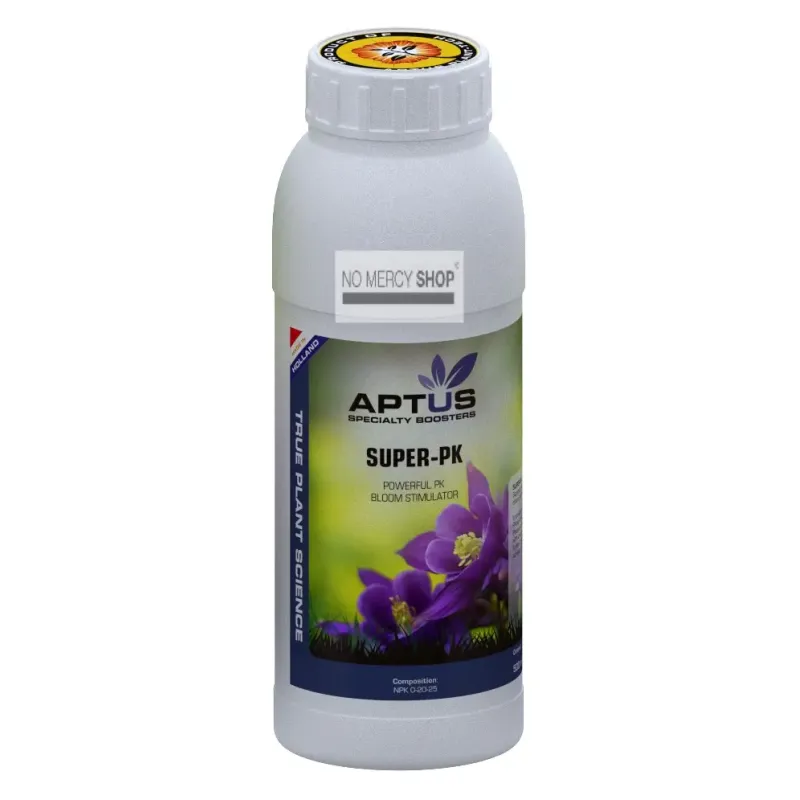
Aptus - Super-PK
Phosphorus and potassium in one bottle, where P-Boost and K-Boost give them separately.
- Aptus
- Model: f103300
- EAN:

QUALITY

PAYMENT

SHIPPING

PACKAGED
Carefully selected products.
Fast and secure checkout experience.
EU-wide delivery from trusted stock.
Carefully and discreetly packaged.
An organo-mineral bloom stimulator with phosphorus and potassium, enriched with L-amino acids and vitamins. Dosed at 1 in 2000 to 1 in 4000, the leanest PK in this range.
13-14 is a convention, not a law of nature
Almost every PK bottle on this shelf carries the same pair of numbers. Not because 13 to 14 is the only correct ratio, but because it is an established trade standard that brands have settled on.
This bottle does it differently, in two ways. It is organo-mineral rather than purely mineral, carrying L-amino acids and vitamins alongside the mineral phosphorus and potassium. And it is dosed considerably leaner: 25 to 50 ml per 100 litres, which is 0.25 to 0.5 ml per litre, against 1 to 2 ml for the mineral 13-14 products.
Aptus also sell P-Boost and K-Boost as separate bottles. That is the real consequence of not committing to a fixed pair of numbers: if you want more potassium and not more phosphorus in a given week, you can, whereas a 13-14 imposes the ratio on you. For anyone working from a leaf analysis or a tight schedule that is the difference between steering and following.
When a fixed ratio gets in your way
Phosphorus and potassium do not peak at the same moment. Phosphorus demand sits mainly with flower initiation and cell formation, early to mid flowering. Potassium keeps running through to ripening, where it serves sugar handling and tissue rigidity.
A fixed-ratio product delivers those two in the same blend every time, so in the final weeks you either take phosphorus you no longer need, or you throttle the potassium because you want to limit the phosphorus. At light doses that hardly matters; at heavy ones it adds up.
This bottle softens that by being dosed lower, and the separate P-Boost and K-Boost resolve it entirely if you want to go that way.
Dosing and order
Mix 25 to 50 ml per 100 litres of clean feed water, which is 1 in 4000 to 1 in 2000. For use through active flowering up to the final flush week before harvest.
Shake the bottle vigorously before use, and add Super-PK only once your base nutrients are fully dissolved in the reservoir. An organo-mineral product contains organic components that can settle out, hence the shaking; and adding it last stops concentrated phosphate meeting a concentrated base feed.
Available sizes
| Size | Price |
|---|---|
| 500 ml | € 15.95 |
| 1 liter | € 28.95 |
| 5 liter | € 129.95 |
Technical Specifications:
- Type: organo-mineral PK bloom stimulator
- Manufacturer: Aptus
- Additional: L-amino acids and vitamins, alongside the mineral phosphorus and potassium
- Dose: 25 to 50 ml per 100 litres, which is 1 in 4000 to 1 in 2000
- Period: active flowering through to the final flush week
- Order: shake vigorously, and add only once the base feed has dissolved
- Related: Aptus sell P-Boost and K-Boost separately for growers who want to steer the ratio themselves
Frequently asked questions
Why does it not say 13-14?
Because that is a trade convention rather than a requirement. This bottle is organo-mineral and built differently from the purely mineral 13-14 products.
Why is the dose so much lower?
It is more concentrated per litre of feed water. That says something about how long a bottle lasts, not that it works harder.
When would I want P-Boost and K-Boost separately?
When you want to steer phosphorus and potassium at different moments. A fixed ratio always delivers both, even when you only need one.
Why does it need such vigorous shaking?
It is an organo-mineral product, with organic components that can settle out.
When do I add it?
Once your base feed has fully dissolved, so concentrated phosphate never meets a concentrated base nutrient.

across Europe

Top brands

across Europe
Top brands