

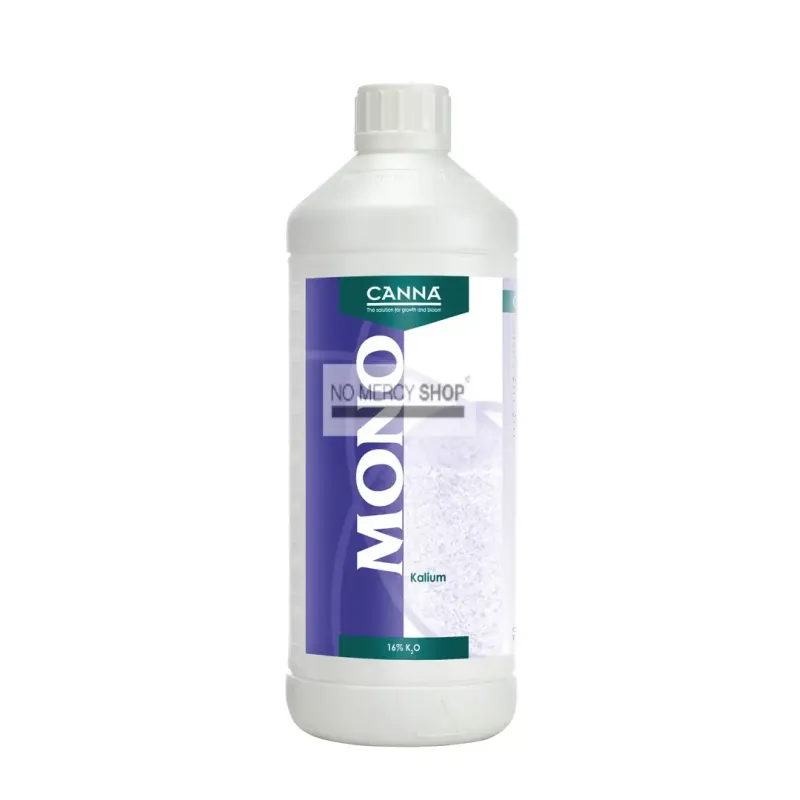
Canna - K 16% Potassium
Potassium on its own, 16% as K2O in citrate form: no nitrogen or sulphate.
- Canna
- Model: f800360
- EAN: 0753321680870

QUALITY

PAYMENT

SHIPPING

PACKAGED
Carefully selected products.
Fast and secure checkout experience.
EU-wide delivery from trusted stock.
Carefully and discreetly packaged.
A single-element potassium fertiliser, NPK 0-0-16 with 16.3% potassium oxide, based on tripotassium citrate. For flowering or for identified potassium deficiencies. 1 to 2 ml per litre.
With a single-element feed the form of the salt matters, not just the element
The label states that this bottle contains tripotassium citrate. Most people skip that detail, and with single-element fertilisers it is the most interesting thing on the label.
Potassium is usually supplied as potassium sulphate or potassium nitrate. A sulphate brings sulphur with it, a nitrate brings nitrogen. Neither has to be a problem, but it is something you receive without asking, and avoiding exactly that is the point of a standalone bottle.
Citrate is the salt of citric acid and supplies neither. You add potassium and, beyond that, an organic acid residue the plant and the soil life simply process. If you want to lift potassium in the final weeks of flowering without pushing your nitrogen up with it, that is the difference between being able to and not.
There is another side to it. Citrate is a chelator: it binds metal ions and holds them in solution. That is the same property that makes citric acid descale kettles, and in a reservoir it works in your favour by discouraging precipitation.
What potassium does in the plant
Potassium is not built into tissue the way calcium or nitrogen is. It circulates as a free ion and regulates water: it sets the pressure inside cells and thereby governs the opening and closing of the stomata.
That makes it the element of rigidity and of coping with stress. A crop with enough potassium holds its stems upright, loses less moisture in heat, and moves sugars to the fruit more efficiently. Which is why demand peaks in flowering and why almost every bloom booster is full of it.
Mixing and dosing
In concentrated form this bottle must not meet calcium- or magnesium-bearing fertilisers. Add it to a reservoir already full of water and stir through before anything else goes in.
Dose 1 to 2 ml per litre of tap water. Bear in mind that potassium competes with calcium and magnesium at the root: a heavy potassium feed can crowd those two out, so do not stack it without reason.
Technical Specifications:
- Type: single-element mineral fertiliser, liquid
- Manufacturer: CANNA
- Registration: NPK 0-0-16
- Content: 16.3% potassium oxide (K2O), water soluble
- Contains: tripotassium citrate
- Does not add: no nitrogen and no sulphate
- Mind the unit: the figure is K2O, not elemental potassium
- Dose: 1 to 2 ml per litre of tap water
- Mixing: do not mix in concentrated form with calcium- or magnesium-bearing fertilisers
- Volume: 1 litre
Frequently asked questions
Why does it matter that it is a citrate?
Because the usual alternatives, sulphate and nitrate, bring sulphur and nitrogen with them respectively. With a citrate you add potassium only.
Is 16% the same as 16% potassium?
No, the figure is K2O. Elemental potassium is lower. Watch for that when comparing brands.
Can I feed potassium without nitrogen with this?
Yes, that is precisely the advantage of this form. Useful in the final weeks of flowering when you are tapering nitrogen.
Does potassium crowd out other elements?
Yes, at the root it competes with calcium and magnesium. A large potassium feed can push those two back.
Why can it not meet calcium and magnesium as a concentrate?
To avoid precipitation. Add everything separately to a full reservoir and stir in between.

across Europe

Top brands

across Europe
Top brands