

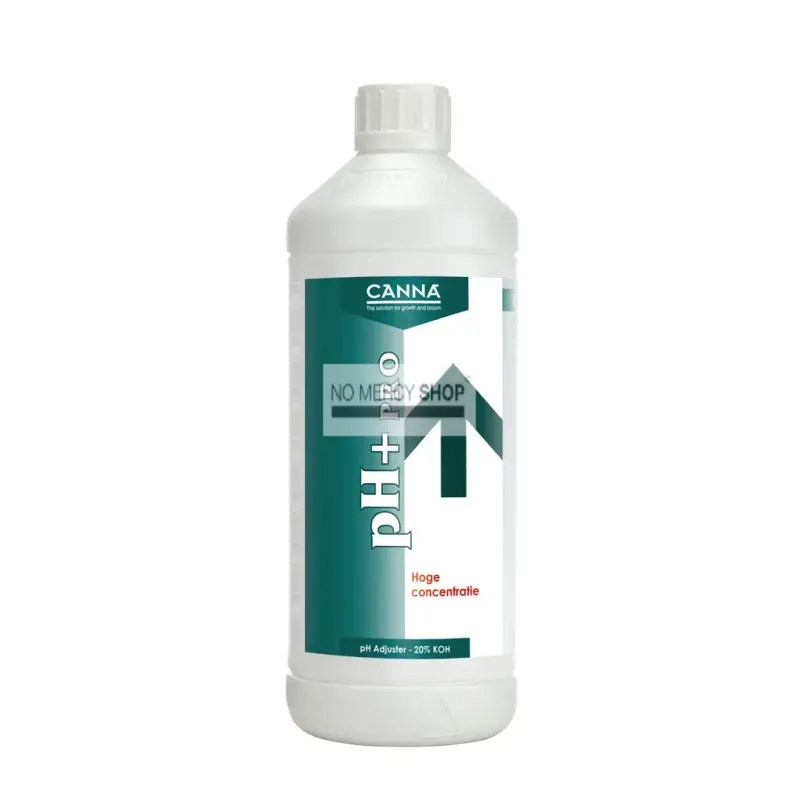
Canna - pH+ 20%
The same pH up at 20%: goes further than the 5%.
- Canna
- Model: f800430
- EAN: 0753321680849

QUALITY

PAYMENT

SHIPPING

PACKAGED
Carefully selected products.
Fast and secure checkout experience.
EU-wide delivery from trusted stock.
Carefully and discreetly packaged.
The stronger of CANNA's two pH raisers, with 20% potassium hydroxide. Roughly 0.5 ml per 10 litres of nutrient solution, which is a third of what the 5% asks for.
Why pH+ has no grow and bloom version when pH- does
Work through the CANNA range and it stands out: there are two pH- bottles, one for growth and one for flowering, while pH+ comes in a single version you use all cycle. That is not an inconsistency but the logical consequence of how acids and bases work.
In an acid the active part is the hydrogen ion, but what stays behind in your reservoir is the counter-ion: phosphate for phosphoric acid, nitrate for nitric. Both are plant nutrients whose demand differs by phase. You want phosphate in bloom and not in veg, nitrate the other way round. Hence two bottles.
In a base the work is done by the hydroxide ion, and the counter-ion here is potassium. Potassium is not phase-bound: a plant wants it in growth for water regulation and tissue, and in flowering just as much for building sugars. So there is nothing to split. One bottle, whole cycle.
The practical upshot is that with pH+ you never have to think about where you are in the cycle, and this bottle's contribution to your feed schedule always works in the same direction.
The 20% is the bottle for volume, not for strength
This and the 5% contain the same substance. The only difference is how much liquid you need: around 0.5 ml per 10 litres against around 1.5 ml for the 5%.
On a five hundred litre reservoir that is 25 ml against 75 ml per correction, and that is exactly what this bottle is for. It lasts longer, you reorder less often and your measuring jug stays manageable. On a twenty litre bucket the reasoning flips: there you are talking about a millilitre, and a single step with the 20% is quickly larger than the correction you meant to make.
So choose on reservoir size, not on what sounds stronger. A more concentrated product is not an advantage in a small tank but a handicap.
Dosing without correcting back and forth
Mix your nutrients, check the EC and only then correct the pH. Add around 0.5 ml per 10 litres, stir the reservoir right through, give it a moment and only then measure. Stirring matters more here than with a dilute product, because a small volume of concentrated base otherwise sits locally in the tank and your meter reads something other than the average.
If you come out too high, do not automatically correct back with acid. Every swing leaves both potassium and your acid's counter-ion behind and lifts your EC without your having added any feed. Better to approach in smaller steps next time. CANNA give 5.2 to 6.2 depending on your substrate.
Safety and storage
Concentrated potassium hydroxide causes severe burns and may be corrosive to metals. Wear gloves and eye protection, always pour the base into the water rather than the reverse, and keep it away from stainless steel and aluminium parts. Bottle hermetically sealed, in its original packaging, between 10 and 30 degrees, protected from heat, frost and direct sunlight.
Technical Specifications:
- Type: mineral pH raiser, liquid concentrate
- Manufacturer: CANNA
- Composition: 20% potassium hydroxide (KOH)
- Adds: potassium
- Phase: vegetative and generative, no phase split
- Dosage: approximately 0.5 ml per 10 litres of nutrient solution
- Relative to the 5%: about a third of the volume for the same effect
- Recommended pH: 5.2 to 6.2 depending on substrate
- Volume: 1 litre
- Storage: hermetically sealed, in the original packaging, 10 to 30 °C, protected from heat, frost and direct sunlight
- Hazards: causes severe burns, may be corrosive to metals
Frequently asked questions
Why is there no pH+ for flowering?
Because the counter-ion here is potassium, and the plant wants potassium in both phases. With pH- the counter-ion is phosphate or nitrate, and those are phase-bound.
Is this better than the 5%?
Not better, stronger. In a large reservoir that is an advantage, in a bucket a handicap: there a single step quickly exceeds the correction you meant to make.
How much do I save on a large reservoir?
You dose about a third of the volume. On five hundred litres that is 25 ml against 75 ml per correction.
Why do I have to stir so thoroughly?
A small volume of concentrated base does not distribute by itself. Measure too early and your meter reads one spot in the tank rather than the average.
What if I overshoot?
Better not to correct straight back with acid. Every swing raises your EC without adding any feed. Approach your value in smaller steps next time.

across Europe

Top brands

across Europe
Top brands