

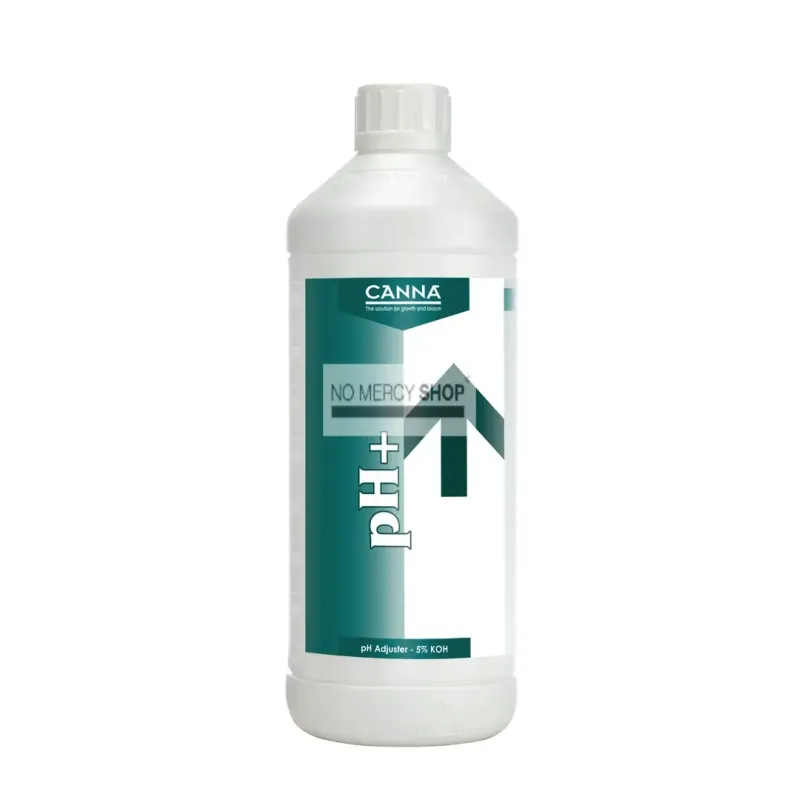
Canna - pH+ 5%
pH up, 5%. Unlike pH down, the phase makes no difference here.
- Canna
- Model: f800420
- EAN: 0753321680832

QUALITY

PAYMENT

SHIPPING

PACKAGED
Carefully selected products.
Fast and secure checkout experience.
EU-wide delivery from trusted stock.
Carefully and discreetly packaged.
The weaker of CANNA's two pH raisers, with 5% potassium hydroxide. Roughly 1.5 ml per 10 litres of nutrient solution. Made for small corrections where you do not want to shoot past your target.
A weaker bottle is not a cheaper one, it is a more precise one
CANNA sell the same substance at two strengths, 5% and 20%, and the difference is not quality but the control it gives you. For the 5% CANNA give around 1.5 ml per 10 litres, for the 20% around 0.5 ml. So you dose roughly three times the volume for the same effect.
That sounds like a drawback and in practice is often the opposite. Anyone correcting a twenty or thirty litre bucket is working in doses of a few millilitres. With the 20% you are quickly in the region where one extra drop produces a visible jump on your meter, so you correct back with acid, and end up with a reservoir that has taken both base and acid and an EC higher than you planned. With the 5% that same step is three times smaller and you approach far more gradually.
The rule of thumb is simple. Small reservoirs, mixed by hand, and a pH that needs to come up by a tenth or two: this is the bottle. Large reservoirs of several hundred litres, where the 5% means reaching for a measuring jug: the 20% is more practical.
Potassium hydroxide raises pH and supplies potassium, which always suits
Potassium hydroxide splits in water into hydroxide ions, which raise the pH by mopping up free hydrogen ions, and potassium ions, which stay behind in your solution.
That potassium is not a by-product but one of the three main elements in your base feed, the K in NPK. A plant uses it for water regulation, for opening and closing its stomata and for tissue rigidity, and that demand runs the whole cycle. At the doses involved here the contribution is small, but it is why a pH raiser never works against your schedule the way a pH reducer can in the wrong phase.
This should be the exception, not the routine
Mains water across most of the Netherlands is hard and alkaline by itself, so the usual direction of travel is down, not up. If this bottle features regularly in your routine, look first at why your pH is low.
The three usual causes: you are working on reverse osmosis water, which has no buffer and drifts in every direction; you have overshot with your pH reducer and are correcting back; or your reservoir has stood a while and the substrate and the plant have shifted the acidity. In the second case the real fix is smaller steps with your acid, not more base.
In use
Mix your nutrients first and check the EC, because the feed shifts the pH by itself. Then add around 1.5 ml per 10 litres, stir the reservoir thoroughly and measure again. Repeat until you reach your value. CANNA give 5.2 to 6.2 depending on your substrate.
Never mix undiluted base and undiluted acid together, and pour both only into the made-up reservoir. Potassium hydroxide may be corrosive to metals, so keep it away from your tools and pump housings. Keep the bottle hermetically sealed, in its original packaging, between 10 and 30 degrees, out of the sun and out of frost.
Technical Specifications:
- Type: mineral pH raiser, liquid concentrate
- Manufacturer: CANNA
- Composition: 5% potassium hydroxide (KOH)
- Adds: potassium
- Phase: vegetative and generative, no phase split
- Dosage: approximately 1.5 ml per 10 litres of nutrient solution
- Recommended pH: 5.2 to 6.2 depending on substrate
- Volume: 1 litre
- Storage: hermetically sealed, in the original packaging, 10 to 30 °C, protected from heat, frost and direct sunlight
- Hazards: causes severe burns, may be corrosive to metals
Frequently asked questions
What is the difference from the 20% version?
Concentration only. This one doses at around 1.5 ml per 10 litres, the 20% at around 0.5 ml. This is more precise in small reservoirs, the 20% more practical in large ones.
Do I need a different version for flowering?
No. With pH+ the phase does not matter, unlike pH-. The only thing it adds is potassium, which the plant wants in both phases.
I need pH+ every time, is that normal?
Usually not. Dutch mains water is typically hard and alkaline. If you work on reverse osmosis water, or overshoot your target with acid, that is probably the cause.
Can I mix pH+ and pH- in the same jug?
Never undiluted. Both are concentrated and the reaction is violent. Always correct in the made-up reservoir.
Does it raise my EC?
Slightly, since you are adding potassium ions. At normal corrections that is small, but measure your EC before correcting rather than after.

across Europe

Top brands

across Europe
Top brands