

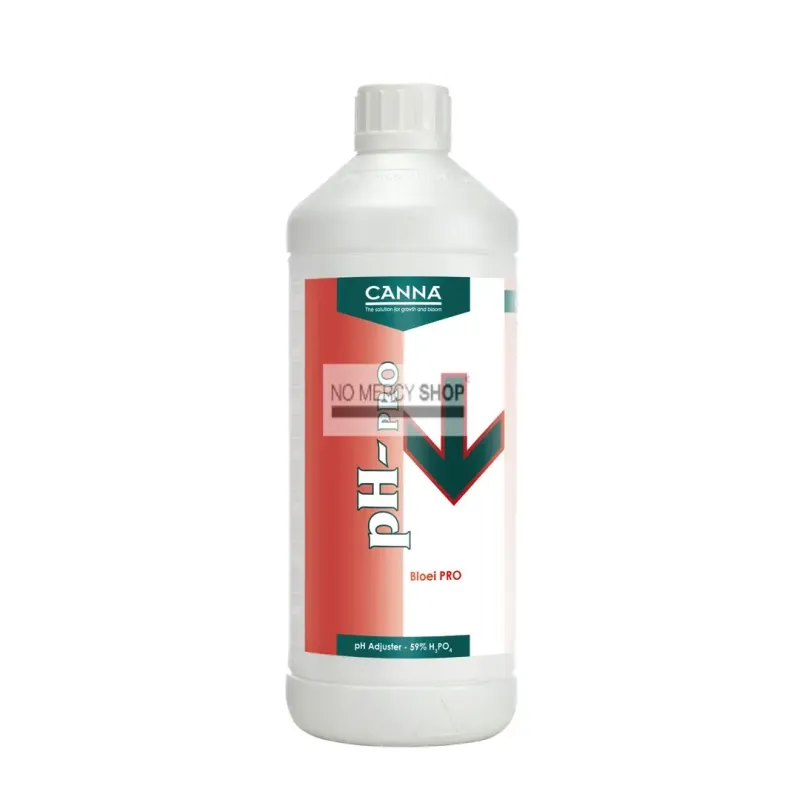
Canna - pH- Pro Bloom
pH down for the FLOWERING phase, a different formulation from the Growth version.
- Canna
- Model: f800410
- EAN: 0753321680641

QUALITY

PAYMENT

SHIPPING

PACKAGED
Carefully selected products.
Fast and secure checkout experience.
EU-wide delivery from trusted stock.
Carefully and discreetly packaged.
A highly concentrated mineral pH reducer from CANNA for the flowering phase, based on 59% phosphoric acid. Roughly 0.5 ml per 10 litres of nutrient solution.
You are dosing phosphate here, whether you planned to or not
Phosphoric acid is H3PO4, and the moment it enters your reservoir it splits into hydrogen ions, which bring the pH down, and phosphate ions, which stay behind. Those phosphate ions are not waste: it is exactly the same phosphate that sits in your PK booster and in the P of your base nutrient. During flowering that is usually good news, and it is why CANNA picks phosphoric acid for this phase.
It is still worth tracking. In the weeks when you are feeding a PK 13/14 or a comparable bloom booster there is already plenty of phosphate in solution, and a reservoir of hard water that needs serious acidifying adds noticeably to it. Two things to watch: your EC climbs faster than your feed chart would suggest, and an excess of phosphate can interfere with zinc and iron uptake. If you see leaf discolouration in the weeks when you are both boosting heavily and acidifying heavily, this is one of the places to look.
The practical conclusion is not to acidify less, because the pH has to be right regardless. It is to treat your phosphate as a single total: what comes from the base feed, what comes from the booster, and what comes from the bottle on this page.
If you run CANNA PK 13/14, read this first
There is one combination CANNA themselves warn about, and it is precisely the one that suggests itself during flowering: this pH reducer together with CANNA PK 13/14.
The reason follows from everything above. PK 13/14 is 13% phosphorus pentoxide, and this bottle adds further phosphate with every correction. In exceptional cases that exceeds what the solution can hold and saturation occurs. CANNA are clear about what that means: salt compounds form that will not redissolve and that the plant cannot take up, the feed in the tank is finished, and the tank has to be cleaned to prevent further precipitation.
CANNA's advice in that case is to switch to pH- Grow, which works on nitric acid and therefore brings no phosphate with it. That is the same bottle you use in the vegetative phase; there is nothing extra to buy. Also keep the pH in your reservoir below 7.0, because a high pH raises the saturation risk considerably.
Why reverse osmosis water makes acidifying so much cheaper
How much acid a reservoir asks for is not set by the pH of your tap water but by its buffering capacity, which is to say its bicarbonate content. Dutch mains water is hard across much of the country, which means you have to dose substantially before the pH moves at all. Work on reverse osmosis water and that buffer is gone, so the pH shifts on a few drops.
That has two consequences that pull against each other. On RO water you use far less acid and therefore add far less unplanned phosphate. But the same missing buffer makes the pH restless: it drops through your target easily and creeps back up over the following days. On RO water, dose in smaller steps and measure more often than you were used to on hard water.
Dosing and measuring
Only add the acid once your nutrients are mixed and your EC is right, because the feed moves the pH by itself. Around 0.5 ml per 10 litres is CANNA's guideline. Stir thoroughly, measure, and repeat the step until you reach your target. CANNA gives 5.2 to 6.2 depending on substrate: in coco and hydro you sit at the lower end of that range, in soil at the upper end.
Safety
Concentrated phosphoric acid causes severe burns and eye damage, and this product carries an explicit warning about absorption through the skin. Avoid all contact, wear gloves and eye protection and keep the work area clean. Keep the bottle hermetically sealed, in its original packaging, out of reach of children.
Technical Specifications:
- Type: mineral pH reducer, liquid concentrate
- Manufacturer: CANNA
- Composition: 59% phosphoric acid (H3PO4)
- Phase: generative
- Dosage: approximately 0.5 ml per 10 litres of nutrient solution
- Recommended pH: 5.2 to 6.2 depending on substrate
- Volume: 1 litre
- Storage: hermetically sealed, in the original packaging, 10 to 30 °C, protected from heat, frost and direct sunlight
- Hazards: causes severe skin burns and eye damage, danger of absorption through the skin, avoid all contact
Frequently asked questions
Does the phosphate from this bottle count towards my schedule?
At normal doses on soft water, barely. On hard water, where you need a great deal more, the contribution becomes noticeable, particularly in the weeks when a PK booster is in the tank as well.
Can I use it during vegetative growth?
It works, but you would be adding phosphate at the point when the plant mainly wants nitrogen and potassium. That is what the grow version is for.
Why do I need more than the grower down the road?
Most likely because your tap water is harder. It is not the pH of your water that sets how much acid you need, but the amount of bicarbonate in it.
My pH creeps back up after a day, what am I doing wrong?
Probably nothing. Phosphoric acid does not break down, but the plant takes up ions and the substrate releases them, so pH always moves in a recirculating reservoir. Measuring and correcting daily is part of the job.
Can I mix this in the same bucket as pH+?
Never undiluted together. Both are concentrated and the reaction is violent. Always correct in the made-up reservoir.

across Europe

Top brands

across Europe
Top brands