

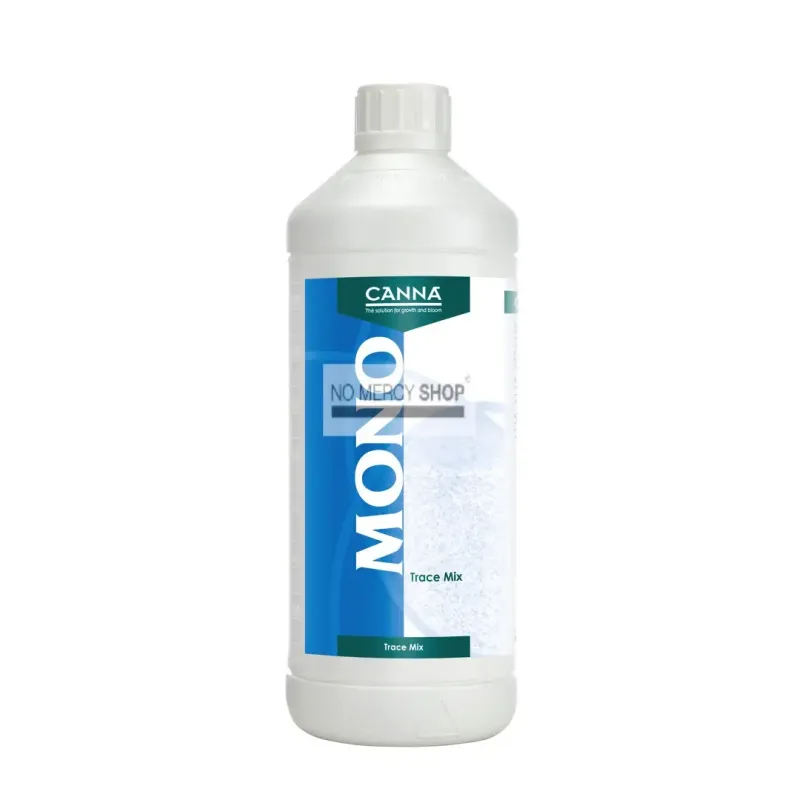
Canna - Trace Mix
Trace elements in one bottle: zinc, copper, molybdenum, boron and manganese.
- Canna
- Model: f800300
- EAN: 0753321680917

QUALITY

PAYMENT

SHIPPING

PACKAGED
Carefully selected products.
Fast and secure checkout experience.
EU-wide delivery from trusted stock.
Carefully and discreetly packaged.
A blend of six trace elements: iron, manganese, zinc, boron, copper and molybdenum. For deficiencies or as a standing top-up through the whole cycle, at 1 to 2 ml per litre.
With these elements, enough and too much sit close together
Trace elements are called that because the plant needs very little of them. Look at the declaration on this bottle and the order of magnitude is immediate: 0.6% manganese, 0.3% boron, 0.3% zinc, and less than a tenth of a percent each of molybdenum and copper.
Those small figures are not thrift but necessity. With the major elements there is a wide margin between a shortage and an excess in which nothing much happens. With trace elements that margin is narrow, and with boron it is the narrowest of all: the amount that corrects a deficiency and the amount that does damage sit closer together than for any other element.
That makes overdosing a real rather than a theoretical risk here. An excess of trace elements is also hard to read, because the symptoms resemble a deficiency: discolouration and distorted young leaf. Anyone responding to that by feeding more makes it worse.
So the rule is: stick to the dose, and use this for an identified deficiency or as a steady low top-up, not as something you adjust by feel.
Why a mix makes more sense than six bottles
You could buy these elements separately, and for iron that bottle exists in this range. For the rest it rarely makes sense, for two reasons.
The first is that trace elements are seldom short on their own. They are made unavailable by the same conditions, above all by a pH that is too high, so if one drops out the others usually go with it.
The second is the margin above. Measuring six elements separately in quantities of tenths of a percent is exactly the kind of work where a mistake gets expensive. In a mix the manufacturer has already fixed the proportions.
The iron in this blend is chelated with DTPA and EDDHA. Those are two different chelates with different pH ranges, EDDHA holding up highest. The combination is meant to keep the iron available across a wider pH range than either chelate alone would manage.
Mixing and dosing
Mix 1 to 2 ml per litre of tap water. In concentrated form this blend must absolutely not meet a calcium-bearing fertiliser directly: add it to a reservoir already full of water and stir through.
Technical Specifications:
- Type: trace element blend, liquid
- Manufacturer: CANNA
- Iron (Fe): 0.06%, chelated with DTPA and EDDHA
- Manganese (Mn): 0.6%
- Boron (B): 0.3%
- Zinc (Zn): 0.3%
- Molybdenum (Mo): 0.07%
- Copper (Cu): 0.06%
- Dose: 1 to 2 ml per litre of tap water
- Mixing: never mix in concentrated form directly with calcium-bearing fertilisers
- Volume: 1 litre
Frequently asked questions
Why are the percentages so low?
Because the plant needs very little of these elements. The margin between enough and too much is narrow, and narrowest for boron.
How do I know if I have an excess?
It is hard, because the symptoms resemble a deficiency: discolouration and distorted young leaf. Feeding more then makes it worse. Stick to the dose.
Why two kinds of iron chelate?
DTPA and EDDHA have different pH ranges, with EDDHA holding up highest. Together they keep iron available across a wider range.
Can I buy these elements separately?
For iron a standalone bottle exists. For the rest a mix is more practical, since trace elements are seldom short alone and measuring them individually at these quantities invites mistakes.
Why can it not meet calcium?
To avoid precipitation in the concentrate. Add it to a full reservoir and stir through.

across Europe

Top brands

across Europe
Top brands