

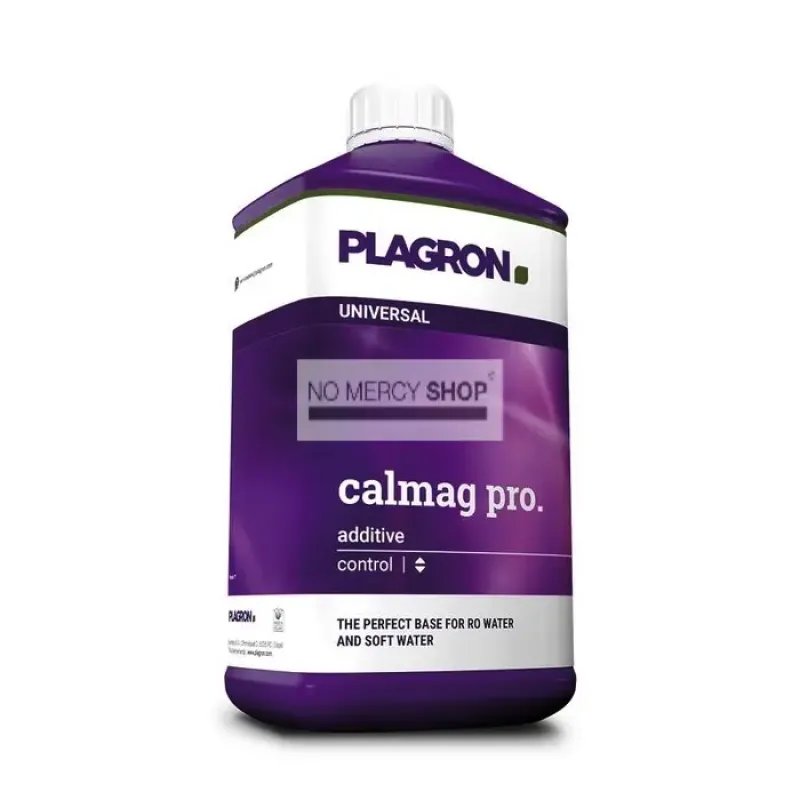
Plagron - Calmag Pro
Calcium and magnesium together, to stay ahead of deficiencies.
- Plagron
- Model: f900858
- EAN:

QUALITY

PAYMENT

SHIPPING

PACKAGED
Carefully selected products.
Fast and secure checkout experience.
EU-wide delivery from trusted stock.
Carefully and discreetly packaged.
A calcium and magnesium supplement for reverse osmosis, demineralised and soft tap water. The only one on this shelf whose manufacturer publishes a full analysis. Maximum 1 ml per litre, at every watering.
Four of the five do not say what is in them
Cal-Mag bottles are hard to compare, and not because they are complicated. It is because most brands publish no analysis. You read that it supplements calcium and magnesium, you read a dose, and that is where it stops.
Plagron's technical data sheet does give figures: nitrogen 5.1%, entirely as nitrate, calcium oxide 5.7% and magnesium oxide 3.3%. Alongside those, an acidity of 4.3, a conductivity of 128 mS per centimetre and a density of 1.26 grams per millilitre.
That makes this the bottle you can actually calculate with. Know how much calcium you are adding and you also know whether you are adding enough, and you can tell whether a deficiency really comes from your water or from somewhere else.
Ca 4.1% and CaO 5.7% are the same number
Plagron's product page says calcium 4.1% and magnesium 2%. Their data sheet says calcium oxide 5.7% and magnesium oxide 3.3%. That looks contradictory and is not: the first is the element, the second the oxide form, and one converts into the other.
Calcium oxide is 71.5% calcium by mass, so 5.7 times 0.715 is 4.08. Magnesium oxide is 60.3% magnesium, so 3.3 times 0.603 is 1.99. Same bottle, two notations.
This is more than trivia. This shelf holds products declaring their content as the element and products declaring it as the oxide, without the packaging drawing attention to the difference. Put a 15% bottle next to a 4.1% bottle, conclude the first is nearly four times stronger, and you may be right or you may have made an arithmetic error. So always check whether it says Ca or CaO before setting two numbers side by side.
There is nitrogen in it, and it counts in your schedule
The registration is NPK 5-0-0. That is not a footnote: with every watering you are adding 5.1% nitrogen, entirely in nitrate form.
At one millilitre per litre that is a small amount, but it is there, and it is there all cycle. If you deliberately taper nitrogen through the final weeks of flowering, this is a source that carries on while you think you have shut it off. If you see darker leaf than you expect in those weeks, look here.
Nitrate nitrogen is incidentally the form the plant takes up directly, and it is also the form that supports calcium transport within the plant. Its presence is not an accident.
Dosing
Shake well before use. Add a maximum of 1 ml per litre of water, which is 1 in 1000, and use that solution at every watering. Plagron describe it explicitly as the base you build your feed water on: get the water right first, then the rest.
Available sizes
| Size | Price |
|---|---|
| 500 ml | € 9.25 |
| 1 liter | € 13.75 |
| 5 liter | € 59.50 |
Technical Specifications:
- Type: NPK fertiliser (5-0-0), liquid
- Manufacturer: Plagron
- Total nitrogen (N): 5.1%, entirely as nitrate nitrogen
- Calcium oxide (CaO): 5.7%, equivalent to 4.1% calcium
- Magnesium oxide (MgO): 3.3%, equivalent to 2% magnesium
- Acidity: pH 4.3
- Conductivity: 128 mS/cm
- Density: 1.26 g/ml
- Dose: maximum 1 ml per litre of water (1 in 1000), at every watering
- Intended for: reverse osmosis, demineralised and soft tap water
- Substrate: soil, coco and hydroponics
Frequently asked questions
Why are there two different calcium figures?
Because both the element and the oxide form are declared. 5.7% CaO is equivalent to 4.1% Ca. Same bottle.
Does the nitrogen count in my feed schedule?
Yes. It is NPK 5-0-0 with 5.1% nitrate nitrogen, and it keeps coming as long as you keep feeding it. Watch that when tapering nitrogen in the final weeks.
Do I need this on hard tap water?
Usually far less. The product is meant for reverse osmosis, demineralised and soft water, where calcium and magnesium are naturally absent.
When do I add it?
First, into clean water, before your base nutrients. Plagron describe it as the base you build your feed water on.
Can I give more than 1 ml per litre?
Plagron give 1 ml per litre explicitly as a maximum. More calcium also means less magnesium uptake, so more is not better here.

across Europe

Top brands

across Europe
Top brands