

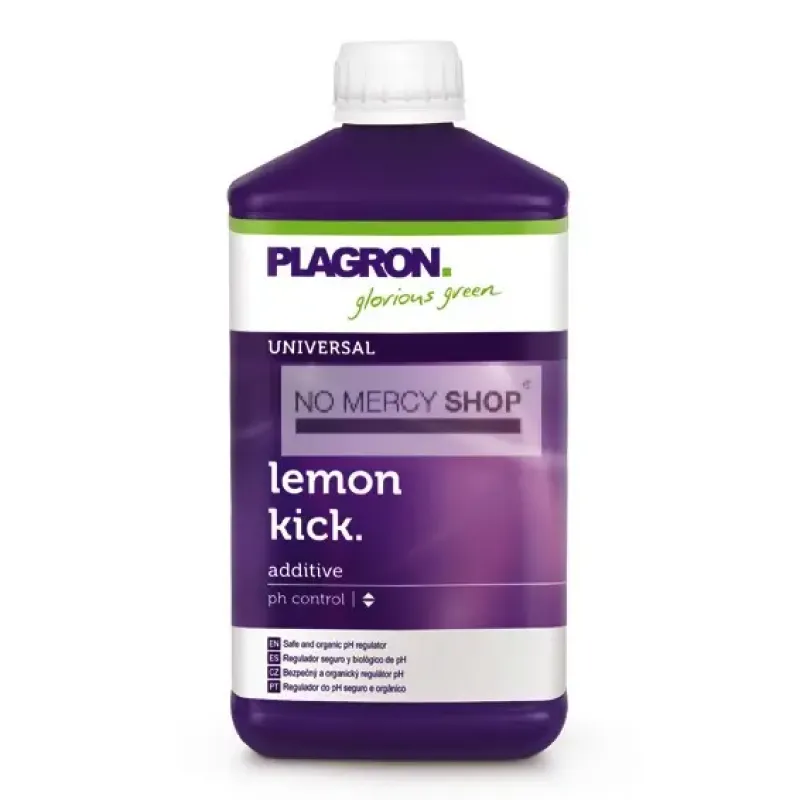
Plagron - Lemon Kick
pH down on citric acid: the organic alternative to pH Min.
- Plagron
- Model: f900884
- EAN:

QUALITY

PAYMENT

SHIPPING

PACKAGED
Carefully selected products.
Fast and secure checkout experience.
EU-wide delivery from trusted stock.
Carefully and discreetly packaged.
An organic pH reducer from Plagron based on citric acid, developed for growers who want to acidify without touching soil life and without shifting their NPK ratios. Target range 5.5 to 6.5.
Two data sheets side by side, and the difference is enormous
Plagron publish a technical data sheet for both Lemon Kick and their mineral pH Min, and setting the two next to each other says more than any product description.
Conductivity of the concentrate is 10.6 mS per centimetre for Lemon Kick. For pH Min it is 207. Acidity of the concentrate is 1.2 for Lemon Kick, and below 1 for pH Min, which Plagron note is too low to measure accurately. Density is 1.11 grams per millilitre against 1.43.
What that tells you is not that one is better than the other, but that these are two fundamentally different liquids. Lemon Kick is more mildly concentrated and gives you more room per drop, which makes it more forgiving on reverse osmosis water or in a small bucket where one drop too many puts you straight through your target. Plagron themselves state that Lemon Kick does not influence the EC value, and 10.6 against 207 is precisely where that comes from.
There is iron in it, and that is where the colour comes from
It is a detail that appears in no sales copy but does appear on the data sheet: Lemon Kick contains 0.195% iron and 0.3% sulphur trioxide. The liquid is accordingly clear yellow rather than colourless.
That is not decoration. Citric acid is a chelator, meaning it binds metal ions and keeps them available in solution rather than letting them precipitate. Iron in chelated form is exactly the element that becomes unavailable first as pH climbs. If you are acidifying a reservoir and a small amount of bound iron comes along with it, that works in the same direction as the reason you were acidifying in the first place.
In practice: expect a faint yellow tint in your reservoir and do not be alarmed by it. On a white substrate or in a translucent tank it is visible.
Why soil life is the argument here
Plagron are explicit about it in their own FAQ: growers working organically do not want to use phosphoric or nitric acid, because it kills their soil life. On top of that, a mineral acid changes your NPK value and Lemon Kick does not.
That makes the choice fairly sharp. If you run a living substrate, with pre-fertilised soil, mycorrhizae or bacterial preparations, then every litre of mineral acid you flush through the pot works against what you paid for. If you run purely mineral in coco or rockwool, there is no soil life to protect and the trade-off is a different one.
Dosing
Shake well before use. Add drop by drop until you are in the 5.5 to 6.5 range, stir and measure again. As with pH Min there is no fixed dose: how much you need depends on the hardness of your water and on how much nutrient is already in it.
One thing that differs from a mineral acid: citric acid is biodegradable, so in a reservoir left standing it is slowly broken down by bacteria and the pH creeps back up. The warmer and the fuller the tank, the faster. Measure more often, and refresh a standing reservoir rather than correcting it repeatedly.
Available sizes
| Size | Price |
|---|---|
| 500 ml | € 7.95 |
| 1 liter | € 12.50 |
Technical Specifications:
- Type: organic pH reducer based on citric acid
- Manufacturer: Plagron
- Composition: water, citric acid
- Sulphur trioxide (SO3): 0.3%
- Iron (Fe): 0.195%
- Acidity of the concentrate: pH 1.2
- Conductivity of the concentrate: 10.6 mS/cm
- Density: 1.11 g/ml
- Appearance: clear yellow liquid, odourless, no foaming
- Target range: pH 5.5 to 6.5
- Effect on NPK: none, it does not shift your nutrient ratios
- Storage and transport: between 0 and 35 °C, frost-free and out of direct sunlight
- Shelf life: 4 years from production, unopened
Frequently asked questions
Why is the liquid yellow?
Because of the iron in it, 0.195% according to Plagron's data sheet. Citric acid binds metal ions and holds them in solution, hence the colour.
Does it damage my soil life?
No, that is the reason it exists. Plagron state that Lemon Kick lowers pH without affecting soil life, where phosphoric and nitric acid do.
Does it change my NPK?
No. That is the second difference from a mineral acid: phosphoric leaves phosphate behind and nitric leaves nitrate, citric adds neither.
Why does my pH creep back up after a day?
Citric acid is biodegradable and gets broken down by bacteria in a standing reservoir. Measure more often than with a mineral acid, and refresh a tank that has stood for a while.
Can I use it in hydro and coco?
You can, but then you lose the argument: in an inert substrate there is no soil life to protect. In a living substrate the difference from a mineral acid is at its largest.

across Europe

Top brands

across Europe
Top brands