


QUALITY

PAYMENT

SHIPPING

PACKAGED
Carefully selected products.
Fast and secure checkout experience.
EU-wide delivery from trusted stock.
Carefully and discreetly packaged.
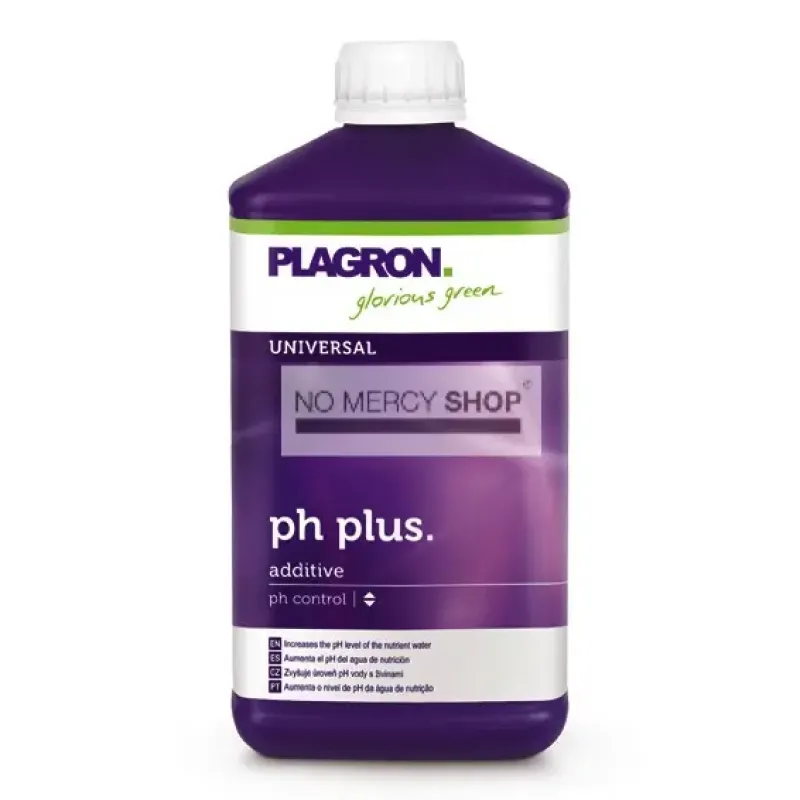
A highly concentrated pH raiser based on potassium hydroxide, registered by Plagron as an NPK fertiliser 0-0-25. Dose drop by drop until you land in the 5.5 to 6.5 range.
If you need this often, the pH is not the problem
A bottle of pH raiser should be gathering dust in most grow rooms. Mains water across most of the Netherlands is hard, sits around pH 7.5 to 8 by itself, and most base nutrients push the made-up solution further up rather than down. So the normal direction of correction is downward.
If you nonetheless find yourself over the reservoir with this bottle regularly, look at the cause before reaching for the correction.
The first and by far the most common: you overshot with your pH reducer. A concentrated acid acts faster in a small reservoir than your meter responds, so you correct back. Plagron themselves advise against that back and forth, precisely because both bottles are fertilisers and every swing shifts the NPK ratio of your feed.
The second: you are working on reverse osmosis water. The bicarbonate buffer has been stripped out, so the pH has nothing to hold on to and moves in every direction on a few drops. There this bottle genuinely is your tool, but the real fix is smaller steps in both directions.
The third: your reservoir has stood for days. The plant takes up ions and the substrate releases them, so acidity drifts by itself in a recirculating system. You correct that, but at some point refreshing is wiser than continuing to adjust.
The data sheet has a blank field, and that is the answer
Plagron publish a technical data sheet for this product with a table of physical properties. Against acidity it says "above 14". Against conductivity there is nothing at all: only a pointer to the footnote saying the value falls outside the measurable range.
A manufacturer leaving a field empty because their own equipment cannot cope with it tells you more about how to handle the bottle than any percentage would have. This is not a product where you measure out a dose and stick to it. It is one where you work by the drop and measure after every drop.
What the data sheet does pin down is the nutrient value. 25.2% water-soluble potassium oxide, registered as NPK 0-0-25, at a density of 1.29 grams per millilitre. Clear, colourless, odourless and non-foaming, which means that in a translucent reservoir you cannot see where it went: so always stir thoroughly before you put your meter in.
Potassium and hardening the plant
Plagron list among this product's properties that it aids in hardening the plant. That is not a stray marketing line but follows from what is in the bottle.
Potassium is the element that governs the plant's water regulation. It sets the pressure inside the cells, and that pressure is what holds a stem upright and keeps a leaf firm rather than limp. A plant with enough potassium has thicker cell walls, loses less moisture through the leaf and copes better with heat and with a stretch where the watering slips.
At the doses involved here that contribution is modest and it is no reason to treat this bottle as a potassium feed. It does explain why a pH raiser never works against your crop the way an acid can in the wrong phase, and why Plagron mention the property at all.
In use
Shake before use. Mix your nutrients and check the EC first, then correct the pH. Add drop by drop, stir the reservoir right through and measure again. There is no fixed dose on the bottle and there cannot be one, because the amount required depends on your water quality and on how much nutrient is in the tank. Target range 5.5 to 6.5.
Available sizes
| Size | Price |
|---|---|
| 500 ml | € 7.75 |
| 1 liter | € 11.50 |
Technical Specifications:
- Type: pH raiser based on potassium hydroxide
- Manufacturer: Plagron
- Registration: NPK fertiliser 0-0-25
- Potassium oxide (K2O): 25.2%, water soluble
- Acidity of the concentrate: pH above 14, too high to measure accurately
- Conductivity of the concentrate: too high to measure accurately
- Density: 1.29 g/ml
- Appearance: clear, colourless and odourless liquid, no foaming
- Target range: pH 5.5 to 6.5
- Application: suitable for all watering systems, vegetative and flowering phase
- Dosage: shake well, then add drop by drop and keep measuring
- Storage and transport: between 0 and 35 °C, frost-free and out of direct sunlight
- Shelf life: 4 years from production, unopened
Frequently asked questions
Why do I almost never need this?
Because Dutch mains water is typically hard and alkaline. The usual correction goes down. If you do need it often, look at reverse osmosis water or at overshooting with your acid.
How does it differ from Calcium Kick?
This bottle corrects the pH of your water, in the reservoir. Calcium Kick is meant to raise the pH of your soil and works through lime in the substrate. If your acidity problem is in the pot rather than the tank, that is the other side of the range.
My pH drops again after a day, should I keep correcting?
Once, fine; twice, still fine; after that refreshing is wiser. In a recirculating reservoir the plant takes up ions and the substrate releases them, so acidity keeps moving. Continuing to correct means stacking potassium into water that was due for replacement anyway.
Does the potassium count in my feed schedule?
The product is registered as NPK 0-0-25, so in principle yes. At normal corrections the contribution is small, and unlike phosphate or nitrate, potassium works against you in no phase at all.
Can I add it to my undiluted nutrients?
No. This base belongs only in the made-up reservoir. Undiluted into a concentrated fertiliser it causes precipitation, and into a concentrated acid a violent reaction.

across Europe

Top brands

across Europe
Top brands