

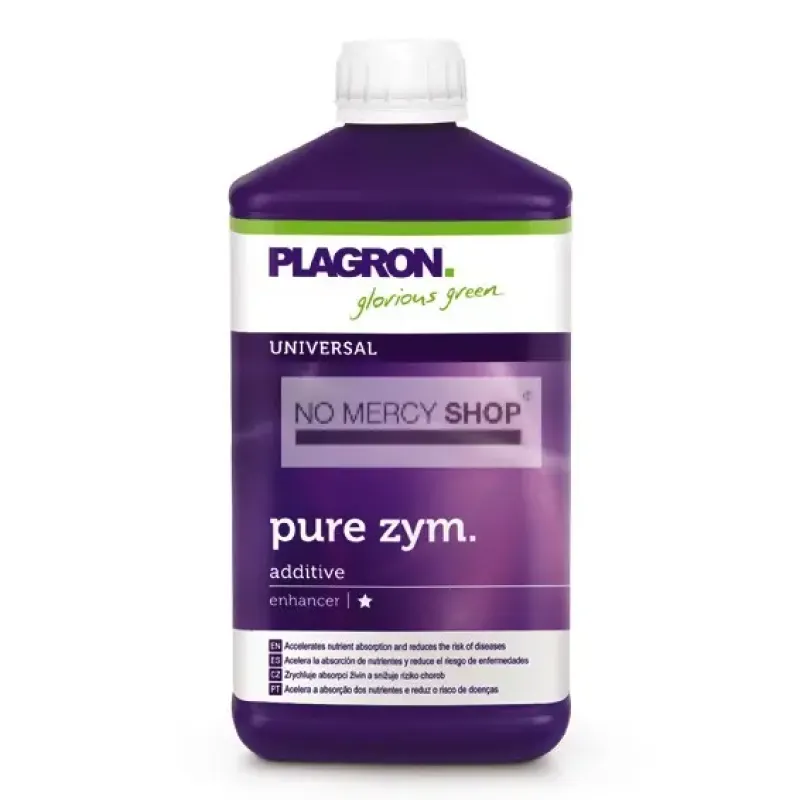
Plagron - Pure Zym
Enzymes that break down dead root matter and keep the substrate clean.
- Plagron
- Model: f900730
- EAN:

QUALITY

PAYMENT

SHIPPING

PACKAGED
Carefully selected products.
Fast and secure checkout experience.
EU-wide delivery from trusted stock.
Carefully and discreetly packaged.
A stabilised enzyme solution from Plagron based on cellulase and beta-glucanase. The only product on this shelf whose manufacturer publishes its enzyme activity in measurable units.
The only one that puts figures on the table
Enzyme products are hard to compare. Almost every bottle says it breaks down dead root material, and almost no bottle says how much enzyme is in it. "Highly concentrated" and "powerful blend" are not units.
In its technical data sheet of January 2026, Plagron publishes three separate activities, each with its own unit of measurement: hemicellulase at 164 BHU(2)HS per gram, endo-cellulase at 53 ECU per gram and beta-glucanase at 143 FBG per gram.
What you can do with that is narrower than it looks, and it is fairer to say so. You cannot set these numbers against a competitor's, because the competitor publishes none. What you can do is track your own bottle's activity across the years, check you are getting the same product as last time, and see that there are three distinct enzyme types in it rather than one.
Watch out for one thing that easily goes wrong: older packaging and many shop pages still quote "25 BPU and 2 FBG". That is a superseded declaration in different units. Go by the current data sheet.
What the three enzymes each do
Cellulase breaks down cellulose, the building material of plant cell walls, and that is what dead roots are made of. Endo-cellulase cuts the chains in the middle and hemicellulase takes on the branched sugars around them. Together they pull the dead material apart into sugars that soil life can actually use.
Beta-glucanase works on glucans, a different group of sugar chains found among other places in fungal cell walls and in slime layers. That is a different target from cellulose, and it is why a blend clears more than a single enzyme does.
Dosing
Shake well before use. Mix 1 ml per litre of water, which is 1 in 1000, and feed that solution at every watering throughout the whole cycle. Plagron specifically say the entire cultivation period; older packaging texts naming the third or fourth week of flowering as an end point are out of date.
Plagron's own tip: use Pure Zym to flush the substrate through when you want to reuse it. Store and transport the bottle between 0 and 35 degrees, upright, dark and frost-free. Unopened it keeps for four years.
Available sizes
| Size | Price |
|---|---|
| 100 ml | € 6.65 |
| 250ml | € 9.75 |
| 500 ml | € 14.50 |
| 1 liter | € 21.95 |
| 5 liter | € 92.95 |
Technical Specifications:
- Type: stabilised enzyme solution
- Manufacturer: Plagron
- Composition: water, sorbitol, sugar, cellulase and pectinase enzymes
- Hemicellulase: 164 BHU(2)HS per gram
- Endo-cellulase: 53 ECU per gram
- Beta-glucanase: 143 FBG per gram
- Acidity: pH 4.8
- Conductivity: 5.6 mS/cm
- Density: 1.12 g/ml
- Appearance: yellow to brown liquid, characteristic odour, no foaming
- Dose: 1 ml per litre of water (1 in 1000), at every watering throughout the cycle
- Storage and transport: between 0 and 35 °C, upright, dark and frost-free
- Shelf life: 4 years from production, unopened
Frequently asked questions
What do BHU, ECU and FBG mean?
They are activity units per gram, each for a different enzyme type. They state how much conversion the product can deliver per gram, not how much enzyme it contains by mass.
My bottle says 25 BPU and 2 FBG, is that wrong?
That is an older declaration in different units that is still widely repeated. Plagron's current data sheet gives the three values above.
How long do I keep feeding it?
Throughout the cycle, at every watering. Texts that stop at the third or fourth week of flowering are out of date.
Can I reuse my substrate with this?
Yes, that is Plagron's own tip: flush the substrate through with it before putting it back to work.
Can I combine it with an organic nutrient line?
If you grow fully organically the soil life already produces its own enzymes and adding more achieves little. On a mineral line the effect is clearest.

across Europe

Top brands

across Europe
Top brands