The pot decides how the roots behave, and the roots decide the rest. It is the cheapest decision in a setup with the largest effect on what happens below ground, and for exactly that reason the one most often made on autopilot.
Circling roots are the problem this range solves
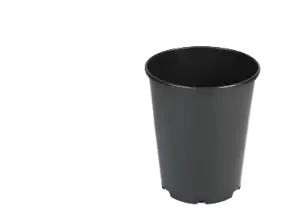
In a smooth plastic pot a root grows until it meets the wall, then carries on along it. It keeps going round, and eventually a dense mat forms against the edge while the middle of the pot is barely colonised. The plant has root mass, but in the wrong place.
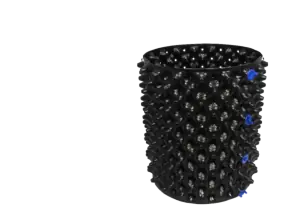
A pot that lets air through behaves differently. As soon as a root tip meets open air it stops growing and the plant branches back into the medium. That is air pruning, and it produces a finely branched root system that uses the whole pot rather than its rim. It is the entire idea behind fabric pots and the perforated airpots.
What it costs: you water more often
A pot that passes air on every side also evaporates on every side. Fabric pots and airpots dry out faster than a closed pot of the same volume, and in a warm tent under a strong lamp you notice that immediately in your watering frequency.
That is a trade rather than a drawback. You get a better-colonised pot in return and far less risk of sitting wet, which is the most common beginner mistake. If watering more often does not appeal, a watering system absorbs it: an airy pot combined with a system that tops up continuously is a particularly good pairing.
Fabric, perforated plastic, or an ordinary pot
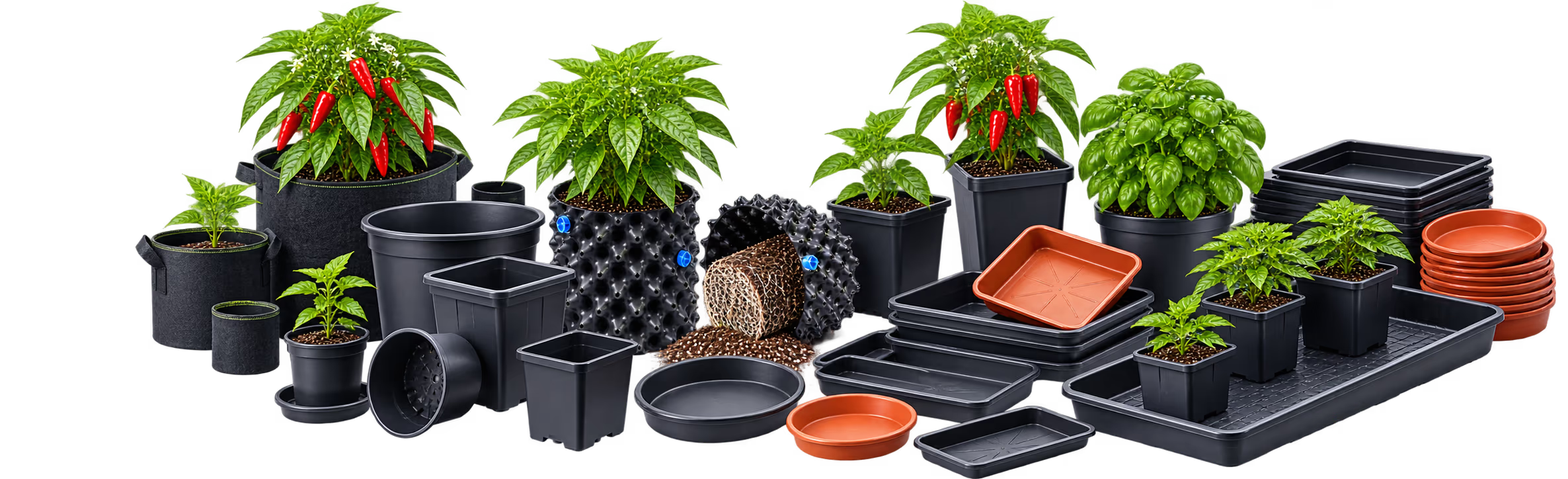
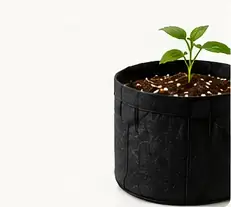
Gronest and Root Pouch supply the fabric pots, from a single litre to well past fifty. Fabric is light, folds flat when not in use and passes air across its whole surface. Airpot and Airmaxx do the same in rigid perforated plastic: they hold their shape, stand more securely and last longer.
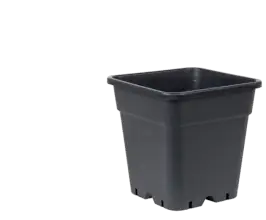
If you stay with solid pots, the choice is mostly spatial. Square pots pack against each other and waste no floor area, which pays most in a tent where every centimetre under the lamp counts. Round pots stand looser and are easier to turn and move. The small propagation pots for cuttings and young plants sit here too.
The tray underneath is not an afterthought
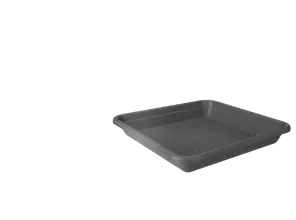
Plant trays catch runoff and keep your tent floor dry, which on its own saves you mould and pests. There is a second reason that gets overlooked: catching runoff means you can measure it. What comes out of the pot tells you more about what is happening in your medium than what you poured in.
With a system that feeds from below the tray is not an accessory at all but a component, since the pot stands in the water the system supplies. The larger square trays from Fertraso and Garland are sized to match tent footprints.
Frequently asked questions
What pot size do I need?
More volume gives room for more root and so a larger plant, but an oversized pot under a small plant stays wet too long. Step up gradually and let pot size follow the plant rather than planting straight into the final size.
Are fabric pots reusable?
Yes. They last several rounds provided you clean them between grows and let them dry completely. Root debris left inside is exactly what you do not want carrying over to the next cycle.
Do I have to water more often in a fabric pot?
Yes, that is the trade. They evaporate across the whole surface. Under a strong lamp in a warm tent the difference is noticeable, and it is precisely why sitting wet is rarely a problem in them.
Square or round?
Square when floor area is scarce, because they pack without waste. Round when you want to turn or move plants regularly.
Why put a tray under my pot?
To catch runoff, keep the floor dry, and be able to measure that runoff. With systems that feed from below, the tray is part of the system itself.