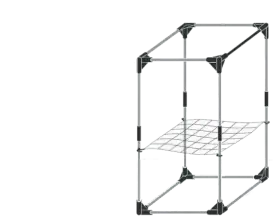
A grow tent is the cheapest way to build a space you can genuinely control. Inside those four walls you set the light, the temperature, the humidity and the airflow, and outside them nobody notices. It is also the purchase with the longest reach, because the size you choose fixes your lamp, your extraction and your plant count for years.
The footprint fixes everything after it
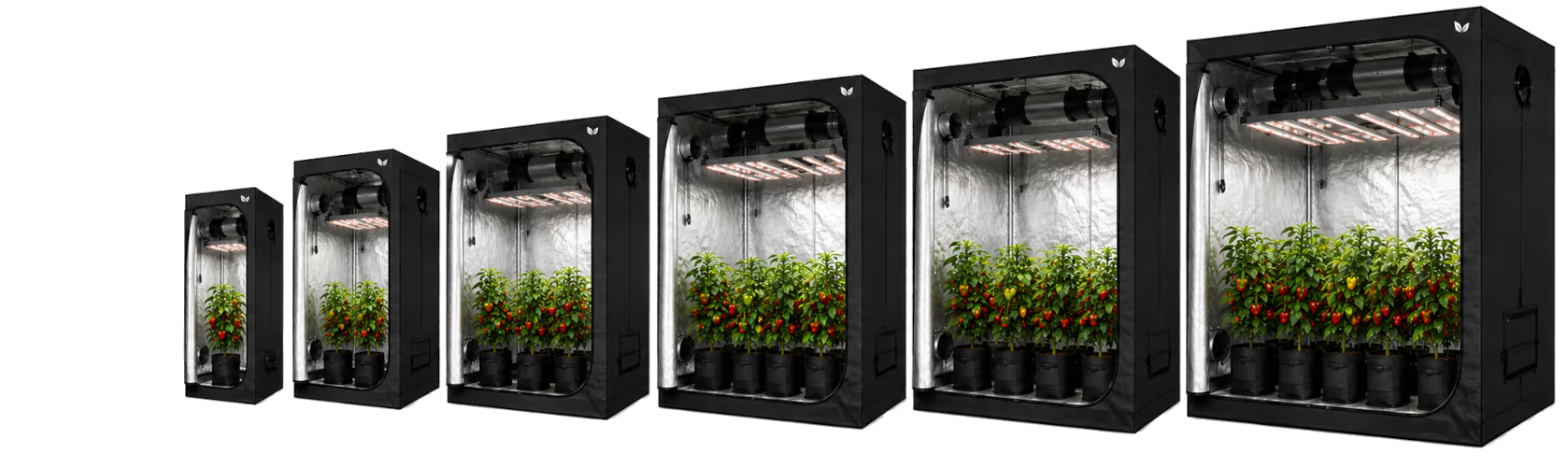
Choose your floor area first, because the rest hangs off it. It decides which lamp fits and what area that lamp has to cover, which duct diameter your extraction will run, and how many pots stand in there without the back row becoming unreachable.
Below 60x60 you are in propagation sizes. 60x60 is the usual first tent and, with fourteen models, the widest choice here. 80x80 and 100x100 are the classic home sizes, and from 120x120 and 150x150 up it becomes a serious setup asking for serious extraction. Rectangles such as 120x60, 90x60 and 60x40 exist because a square often does not fit: against a wall, in a loft or under a sloping roof, a shallow depth buys you more than a bigger floor.
Height deserves the same attention
Floor area gets all the attention and height decides just as much. Above the plant you still need room for the lamp, for the clearance its manufacturer specifies, and for the hanging system above that. What is left over is your actual growing height.
The tents here run from roughly 120 to 220 cm. A low tent is fine for cuttings and for a short, trained plant, but it costs you options the moment you want to go taller. So measure the space the tent will stand in as well as the floor, and subtract lamp clearance and hanging gear before you choose.
A tent, or a cabinet instead
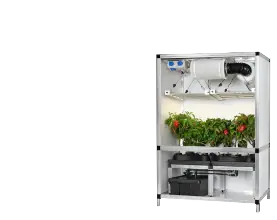
Grow tents are fabric over a frame: light, movable, and foldable when you are done. Grow cabinets from G-Tools are a rigid alternative in board material. They stay put, are sturdier and read less obviously as a grow setup, and some versions have the climate control built in. That costs more space and more money, and it is the choice when a tent has nowhere to go or you want something permanent.
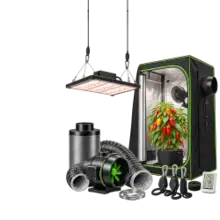
Complete kits are the third route: tent, lamp, fan and filter together, already matched. That removes the guesswork and usually costs less than the separate parts, but you take the combination the manufacturer picked.
The brands differ mostly in finish
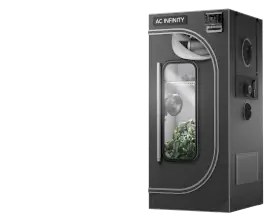
Secret Jardin has the widest programme, from the Dark Street and Hydro Shoot to the Dark Propagator for cuttings, and supplies most of the separate hardware as well. AC Infinity sits at the upper end and also sells its tents as a system with its own control. Homebox builds on a 22 mm frame with its own connectors. Ferna, Dark Box and Garden Highpro cover the common sizes at the entry end.
What keeps a tent sealed is the detail
Tent accessories is the second largest group here at thirty products, and that is no accident. A tent is only as light-tight as its weakest port. This group holds the flanges for taking ducting through a wall cleanly, the light-proof intakes that pass air but block light, the socks for cables, and the patch kits for when something tears anyway.
Alongside those sit the things you need inside: netting to carry branches as they get heavy, grids, ballast holders, and reflective sheeting for turning a room into a usable space. Budget for these, because they are the difference between a tent that works and one that leaks light and smell.
Frequently asked questions
How many plants fit in an 80x80 tent?
That depends more on your pot size and training style than on the tent. A few large plants in generous pots fill the same area as a larger number of small ones. Work from the area your lamp covers evenly, and make sure you can still reach every pot.
What extraction suits which tent?
Work from your room volume to the airflow you need, and pick a diameter only after that. The calculation and the sizes are under Climate & Ventilation.
How tall should a grow tent be?
Taller than your plant plus the clearance your lamp requires plus the hanging system. Measure the room it will stand in too: a 200 cm tent does not go under a 210 cm ceiling if you still want to assemble it.
Is a grow tent really light-tight?
The fabric is. The weak points are the zips and the ports, and light-proof intakes plus properly fitted flanges are where most of the improvement is.
Can I extend a tent later?
Not a tent itself; it is the size it is. The grow cabinets do have expansion modules for enlarging an existing cabinet. If you expect to grow, buying one size up now beats buying a second tent later.