Water is the part that gets the least thought and goes wrong most often without showing it. You measure your nutrient, you measure your pH, and meanwhile the water itself is at the wrong temperature or has been standing too long. This category is about that water: storing it, moving it, keeping it at temperature and spraying it.
Temperature is the quiet factor
Cool water holds more dissolved oxygen than warm water. Let the reservoir climb and oxygen falls away exactly when the roots need it most, and warm, oxygen-poor water is also the condition in which root problems develop fastest. Too cold, on the other hand, simply slows uptake down.
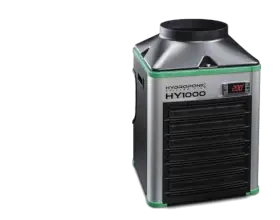
So the corrections for both directions sit here. Barrel heaters for a garage or shed where water drops too far overnight, and water chillers for a reservoir that runs hot in summer, which matters most in systems where roots sit permanently in the solution. The meters are under Measuring & Control.
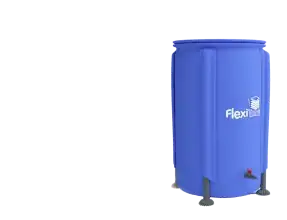
A tank solves more than storage
With a water tank you mix feed in advance instead of remixing at every watering. That saves work, but the bigger gain is time: pH settles after mixing, and mains water reaches room temperature instead of going cold into the pot.
Size it on a full watering plus margin, not on what just fits. The tanks here run from a 50 litre drum to collapsible tanks of several hundred litres. Collapsible is worth considering if the tent is temporary or the tank has to come through a narrow door, since it takes almost no space empty.
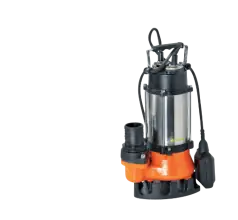
Choose a pump on head height, not just on litres
Pumps are sold on litres per hour, and that figure is at free flow. As soon as the pump has to lift, to a raised tank or up to a table, output falls, and at its maximum head it delivers nothing at all. So read both numbers: the flow rate and the height you need to move water over.
AquaKing covers the range here from submersible pumps for filling a can to pumps that keep a system running, plus flat-suction pumps for emptying a tank or tray down to the last few millimetres. A pump earns its place without a system too: emptying a tank on the floor beats lifting it.
Spraying is a separate job
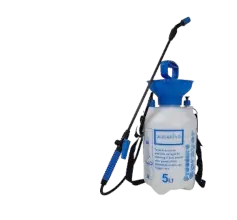
Pressure sprayers are for foliar feed and for crop protection, so for anything that belongs on the leaf rather than in the medium. A pressure sprayer holds pressure so you get a fine, even mist instead of large drops that roll off the leaf.
Keep a separate sprayer for treatments if you can: residues are hard to rinse out completely, and you do not want them going over your leaves later. What goes in them is under Foliar Feed and Plant Health.
Frequently asked questions
What temperature should my water be?
Room temperature is a workable target. Too warm costs oxygen and invites root problems; too cold slows uptake. More important than the exact figure is that it stays stable rather than swinging ten degrees a day.
How big should my tank be?
At least one full watering, with margin. Too small means mixing again halfway, and then the second half of your plants gets something different from the first.
Which pump do I need?
Work out the height you need to lift water over first, then look at the output at that height rather than the maximum on the box. If you are only filling watering cans, head height is barely a factor.
Can I leave mixed nutrient standing in the tank?
Only for a while. A mixed solution changes: pH drifts, and standing water without movement or aeration deteriorates. Mix what you will use within a few days.
Why do I need a separate pressure sprayer?
Because residue from a treatment stays behind in the tank and hose. Use the same sprayer later for foliar feed and you put that residue on your crop after all.